2023 · GS Paper 2 · Q18 · 15 marks
Skill development programmes have succeeded in increasing human resources supply to various sectors. In the context of the statement analyse the linkages between education, skill and employment.
In short
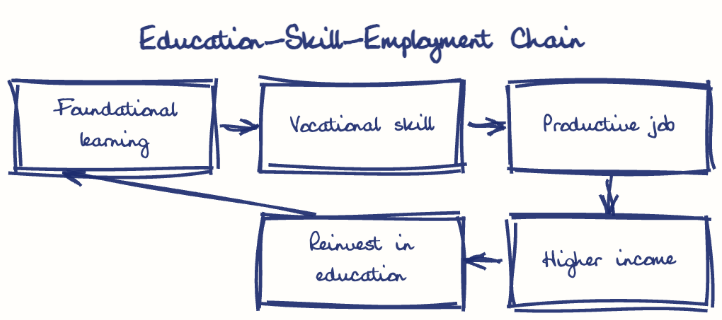
Education makes youth trainable, skill converts learning into productivity and employment funds further education, but the chain breaks at weak foundations and scarce formal jobs. Only 23% of Indian workers hold regular salaried jobs (NITI Aayog, 2024) despite 1.64 crore PMKVY trainees.
Model answer
Ghissu Editorial · Verified 4 Oct 2026 · 274 words
Education enables trainability
Without foundational literacy, technical courses cannot be absorbed, hence NIPUN Bharat's focus on reading and numeracy by Grade 3.
Skill converts learning into productivity
NSQF courses, ITI trades and apprenticeships turn knowledge into paid tasks.
Integration under NEP 2020
Vocational exposure from Class 6 and the National Credit Framework (2023) let academic and vocational credits travel together.
Employability gap
The Economic Survey 2023-24 cited the India Skills Report finding that only about 51% of youth assessed are employable, so degrees signal credentials more than competence.
Educated unemployed
The ILO's India Employment Report 2024 found educated youth were 65.7% of unemployed youth in 2022.
Demand shortfall
Only 23% of workers hold regular salaried jobs (NITI Aayog, 2024) and manufacturing employs 11.4% (PLFS 2022-23).
Close both ends
Universalise foundational learning, embed Germany-style apprenticeships in degrees, upgrade ITIs under PM-SETU, and pair skilling with labour-intensive manufacturing and the Employment Linked Incentive.
This model answer is indicative and the model can make mistakes; please verify key facts independently.
Practise this question
1Get the answer sheet
Sized for this question.
2Write your answer
Timed, by hand.
3Get it marked
Your score and what to fix.
This chapter in the exam
Education9 questions
Asked in 8 of 14 sittings since 2013
- 2026Should education be treated primarily as a welfare obligation of the state or as a strategic investment for building a globally competitive, knowledge-driven nation ? Critically evaluate.
- 2022The Right of Children to Free and Compulsory Education Act, 2009 remains inadequate in promoting incentive-based system for children's education without generating awareness about the importance of schooling. Analyse.
All 9 questions, sorted by sub-topic, with model answers and practice.
Question from the official UPSC Civil Services (Main) Examination 2023 paper. Answer written by Ghissu's engine and checked against our editorial standards. Found an error? Tell us and we correct it within 48 hours.