2026 · GS Paper 2 · Q18 · 15 marks
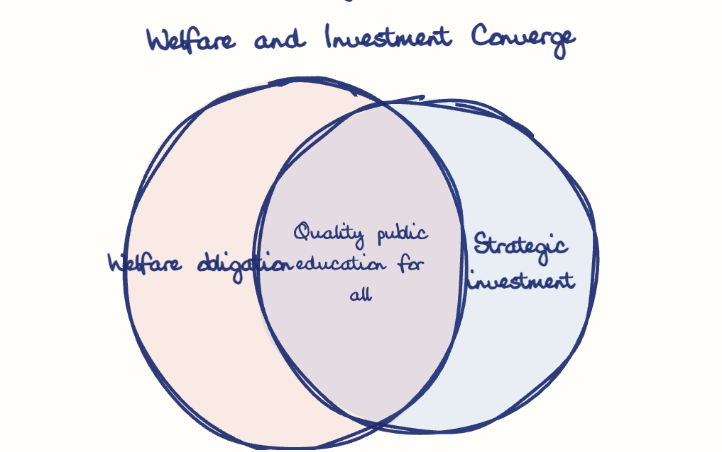
Should education be treated primarily as a welfare obligation of the state or as a strategic investment for building a globally competitive, knowledge-driven nation ? Critically evaluate.
In short
Education should be treated primarily as a welfare obligation at its base, because universal quality schooling is the precondition of any knowledge economy, and as a strategic investment at its apex. India's Global Innovation Index rank rose from 76 in 2014 to 39 in 2024.
Model answer
Ghissu Editorial · Verified 4 Oct 2026 · 287 words
Constitutional entitlement
Unni Krishnan (1993), the 86th Amendment (2002) and the RTE Act 2009 make free schooling for ages 6 to 14 an enforceable duty.
Equity and capabilities
The 25% RTE quota and PM POSHAN draw first-generation, Dalit and girl learners in, and in Sen's capability view education builds citizens, not just workers.
Limit
Enrolment without learning breeds credentials; NITI Aayog (2024) warns schooling years do not reflect actual learning.
Competitiveness
India's Global Innovation Index rank rose from 76 in 2014 to 39 in 2024 as IITs grew from 16 to 23, and the ANRF Act 2023 targets the research base.
Employability
Only 23% of workers hold regular salaried jobs (NITI Aayog, 2024), so curricula must match skills.
Limit
A pure return-on-capital view favours elite institutions, sidelines humanities and risks pricing out the poor.
Fund and measure
Spend 6% of GDP as NEP 2020 urges, track learning through PARAKH, and widen PM-Vidyalaxmi loans so means never block merit.
This model answer is indicative and the model can make mistakes; please verify key facts independently.
Practise this question
1Get the answer sheet
Sized for this question.
2Write your answer
Timed, by hand.
3Get it marked
Your score and what to fix.
This chapter in the exam
Education9 questions
Asked in 8 of 14 sittings since 2013
- 2023Skill development programmes have succeeded in increasing human resources supply to various sectors. In the context of the statement analyse the linkages between education, skill and employment.
- 2022The Right of Children to Free and Compulsory Education Act, 2009 remains inadequate in promoting incentive-based system for children's education without generating awareness about the importance of schooling. Analyse.
All 9 questions, sorted by sub-topic, with model answers and practice.
Question from the official UPSC Civil Services (Main) Examination 2026 paper. Answer written by Ghissu's engine and checked against our editorial standards. Found an error? Tell us and we correct it within 48 hours.