2014 · GS Paper 2 · Q18 · 12 marks
Some of the International funding agencies have special terms for economic participation stipulating a substantial component of the aid to be used for sourcing equipment from the leading countries. Discuss on merits of such terms and if, there exists a strong case not to accept such conditions in the Indian context.
In short
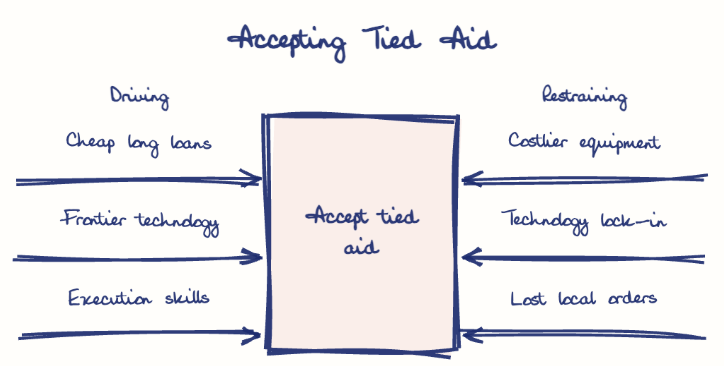
Tied aid brings cheap long-term finance and frontier technology but raises costs, locks India into donor suppliers and sidelines domestic manufacturers. Japan's STEP loan for the Mumbai-Ahmedabad High-Speed Rail, at about 0.1% interest over 50 years, shows when such terms are worth accepting.
Model answer
Ghissu Editorial · Verified 4 Oct 2026 · 270 words
Concessional finance
The high-speed rail loan carries about 0.1% interest over 50 years with a 15-year grace period.
Technology access
Tying brings proven systems such as Shinkansen technology that would take decades to build at home.
Execution and skills
Japanese-funded early phases of Delhi Metro built DMRC's capacity, and later coaches were made by BEML in Bengaluru.
A common practice
India's own Lines of Credit require most of the contract value to be sourced from India.
Higher cost
Without competitive bidding, OECD studies estimate costs rise by 15-30%, which led the OECD in 2001 to recommend untying aid to the poorest countries.
Lock-in and lost orders
Proprietary systems create dependence for spares, and tied purchases sideline Indian makers, against the 2017 Make in India procurement order and the proven Vande Bharat capability.
Currency risk
Debt in yen or euro grows in rupee terms when the rupee weakens, eroding much of the low-interest advantage over a 50-year tenure.
This model answer is indicative and the model can make mistakes; please verify key facts independently.
Practise this question
1Get the answer sheet
Sized for this question.
2Write your answer
Timed, by hand.
3Get it marked
Your score and what to fix.
This chapter in the exam
Donors3 questions
Asked in 3 of 14 sittings since 2013
- 2022Do you agree with the view that increasing dependence on donor agencies for development reduces the importance of community participation in the development process ? Justify your answer.
- 2019The need for cooperation among various service sectors has been an inherent component of development discourse. Partnership bridges the gap among the sectors. It also sets in motion a culture of 'collaboration' and 'team spirit'. In the light of statements above examine India's development process.
Question from the official UPSC Civil Services (Main) Examination 2014 paper. Answer written by Ghissu's engine and checked against our editorial standards. Found an error? Tell us and we correct it within 48 hours.