2022 · GS Paper 2 · Q17 · 15 marks
Do you agree with the view that increasing dependence on donor agencies for development reduces the importance of community participation in the development process ? Justify your answer.
In short
Dependence on donor agencies reduces community participation only when projects are designed abroad and accountable upward to funders; well-designed donor programmes can deepen it. World Bank-backed Velugu and JEEViKA built women's SHG federations that shaped India's National Rural Livelihoods Mission.
Model answer
Ghissu Editorial · Verified 4 Oct 2026 · 270 words
Upward accountability
Logframes and indicators make NGOs answer to funders rather than beneficiaries, as Edwards and Hulme showed.
Pre-set agendas
World Bank support for Sardar Sarovar ended in 1993 after the Morse Review (1992) found that displaced people were not properly consulted.
Tokenism
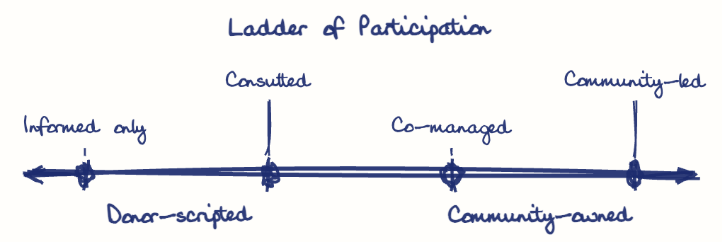
Short project cycles create parallel committees that collapse when funds stop, with people informed but not deciding, Arnstein's tokenism.
Velugu and JEEViKA
World Bank-backed SHG projects in Andhra Pradesh (2000) and Bihar (2007) built women's federations that shaped the National Rural Livelihoods Mission.
Swajal
The Uttar Pradesh hill project (1996) made villages share costs and manage water schemes, later scaled as Swajaldhara.
Limited dependence
India has taken bilateral aid from only a few partners since 2003, yet weak gram sabhas persist in state-funded schemes too.
Ownership compacts
Route donor funds through Gram Panchayat Development Plans, with social audits as a funding condition.
Exit by design
Build federations that outlive projects, backed by CSR and local philanthropy.
This model answer is indicative and the model can make mistakes; please verify key facts independently.
Practise this question
1Get the answer sheet
Sized for this question.
2Write your answer
Timed, by hand.
3Get it marked
Your score and what to fix.
This chapter in the exam
Donors3 questions
Asked in 3 of 14 sittings since 2013
- 2019The need for cooperation among various service sectors has been an inherent component of development discourse. Partnership bridges the gap among the sectors. It also sets in motion a culture of 'collaboration' and 'team spirit'. In the light of statements above examine India's development process.
- 2014Some of the International funding agencies have special terms for economic participation stipulating a substantial component of the aid to be used for sourcing equipment from the leading countries. Discuss on merits of such terms and if, there exists a strong case not to accept such conditions in the Indian context.
Question from the official UPSC Civil Services (Main) Examination 2022 paper. Answer written by Ghissu's engine and checked against our editorial standards. Found an error? Tell us and we correct it within 48 hours.