2019 · GS Paper 2 · Q17 · 15 marks
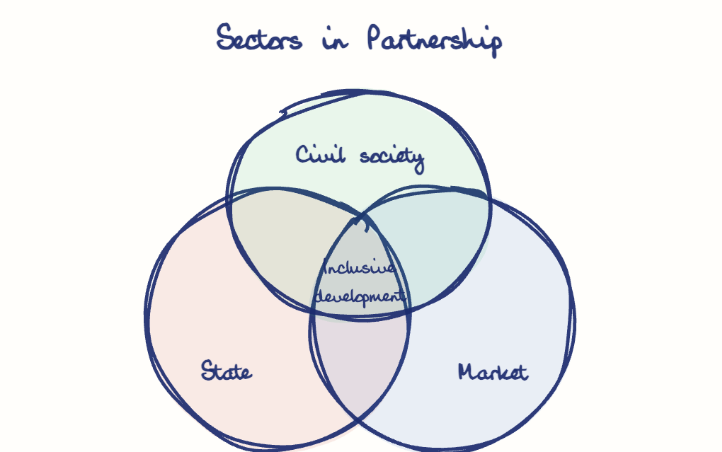
The need for cooperation among various service sectors has been an inherent component of development discourse. Partnership bridges the gap among the sectors. It also sets in motion a culture of 'collaboration' and 'team spirit'. In the light of statements above examine India's development process.
In short
India's development process has shifted from state-led delivery to partnerships among government, markets, communities and civil society, though silos, PPP stress and trust deficits persist. The Aspirational Districts Programme of 2018, built on convergence, collaboration and competition, shows partnership working as a development method.
Model answer
Ghissu Editorial · Verified 4 Oct 2026 · 258 words
State and market
PPPs rebuilt the Delhi and Mumbai airports, and the Hybrid Annuity Model (2016) revived highways by sharing risk.
State and community
DAY-NRLM links over 10 crore women through SHGs (PIB, 2025), and Kudumbashree works with Kerala's local governments.
Across departments
POSHAN Abhiyaan (2018) joins health, child development and water programmes, and PM Gati Shakti (2021) brought 16 ministries onto one digital master plan.
Silo working
Overlapping schemes forced the NITI Aayog sub-group of Chief Ministers (2015) to rationalise centrally sponsored schemes.
PPP stress
Aggressive bidding and disputes stalled projects, which the Kelkar Committee (2015) traced to poor risk allocation.
Trust deficit
Over 20,000 FCRA cancellations by 2024 signal suspicion of civil society.
Convergence by design
Extend joint targets to blocks, as the Aspirational Blocks Programme (2023) began.
Enabling partners
Fair PPP contracts, clear NGO rules under the 2007 Voluntary Sector Policy, and gram sabhas as the shared planning platform.
This model answer is indicative and the model can make mistakes; please verify key facts independently.
Practise this question
1Get the answer sheet
Sized for this question.
2Write your answer
Timed, by hand.
3Get it marked
Your score and what to fix.
This chapter in the exam
Donors3 questions
Asked in 3 of 14 sittings since 2013
- 2022Do you agree with the view that increasing dependence on donor agencies for development reduces the importance of community participation in the development process ? Justify your answer.
- 2014Some of the International funding agencies have special terms for economic participation stipulating a substantial component of the aid to be used for sourcing equipment from the leading countries. Discuss on merits of such terms and if, there exists a strong case not to accept such conditions in the Indian context.
Question from the official UPSC Civil Services (Main) Examination 2019 paper. Answer written by Ghissu's engine and checked against our editorial standards. Found an error? Tell us and we correct it within 48 hours.