2014 · GS Paper 2 · Q2 · 12 marks
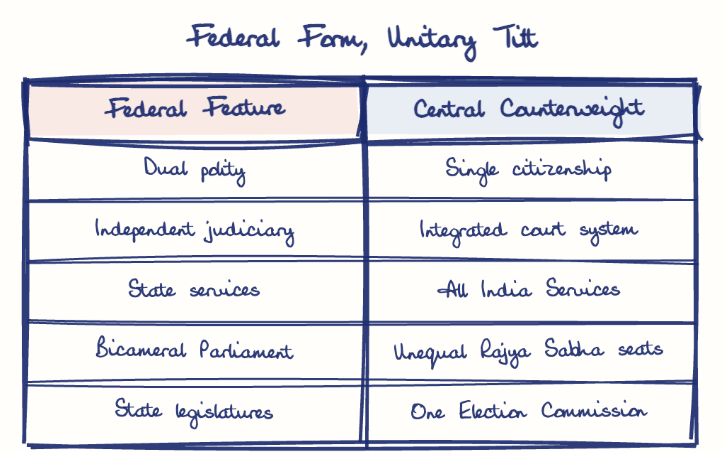
Though the federal principle is dominant in our Constitution and that principle is one of its basic features, but it is equally true that federalism under the Indian Constitution leans in favour of a strong Centre, a feature that militates against the concept of strong federalism. Discuss.
In short
Indian federalism leans towards a strong Centre through residuary and emergency powers, Article 3 and the Governor, but this tilt secures unity without negating federalism as a basic feature. S.R. Bommai (1994) held that states are not mere appendages of the Centre.
Model answer
Ghissu Editorial · Verified 4 Oct 2026 · 295 words
Legislative primacy
Residuary power under Article 248, Union primacy in the Concurrent field under Article 254 and Articles 249 to 253 let Parliament enter State subjects.
Destructible states
Article 3 lets Parliament redraw states by simple majority, as with Andhra Pradesh in 2014.
Emergency and Governor
Articles 352, 356 and 360 can make the system unitary, and Governors may reserve state Bills under Article 200.
Holding-together federation
India was not formed by a compact of states; after Partition and the merger of over 500 princely states, a strong Centre secured unity.
Judicial guardrails
Bommai held that states are not appendages of the Centre and made President's Rule reviewable.
Cooperative channels
The 15th and 16th Finance Commissions kept states' tax share at 41%, and the GST Council pools sovereignty.
Real concerns
Governors withholding Bills, as in the Tamil Nadu dispute decided in 2025, and rising cesses can still squeeze states.
This model answer is indicative and the model can make mistakes; please verify key facts independently.
Practise this question
1Get the answer sheet
Sized for this question.
2Write your answer
Timed, by hand.
3Get it marked
Your score and what to fix.
This chapter in the exam
Issues & Challenges Pertaining to the Federal Structure5 questions
Asked in 4 of 14 sittings since 2013
- 2020Indian constitution exhibits centralising tendencies to maintain unity and integrity of the nation. Elucidate in the perspective of the Epidemic Diseases Act, 1897; The Disaster Management Act, 2005 and recently passed Farm Acts.
- 2020How far do you think cooperation, competition and confrontation have shaped the nature of federation in India? Cite some recent examples to validate your answer.
All 5 questions, sorted by sub-topic, with model answers and practice.
Question from the official UPSC Civil Services (Main) Examination 2014 paper. Answer written by Ghissu's engine and checked against our editorial standards. Found an error? Tell us and we correct it within 48 hours.