2020 · GS Paper 2 · Q3 · 10 marks
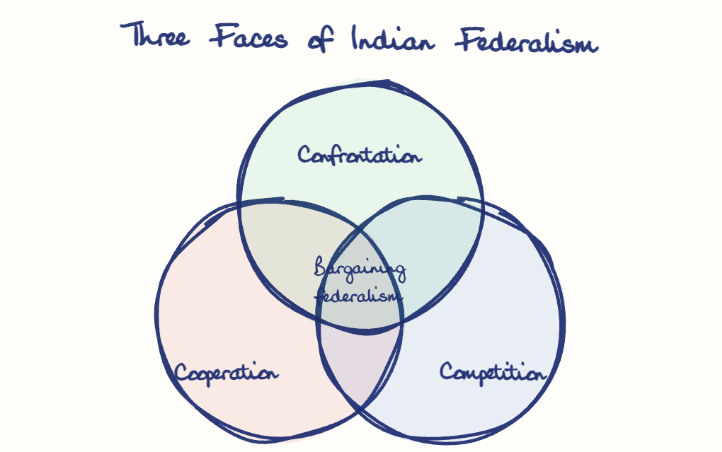
How far do you think cooperation, competition and confrontation have shaped the nature of federation in India? Cite some recent examples to validate your answer.
In short
Cooperation remains the bedrock of Indian federalism and competition its rising engine, while confrontation has shaped it only partly, mostly where rival parties rule. The GST Council under Article 279A shows both cooperation and confrontation, pooling tax sovereignty yet hosting the 2020 compensation dispute.
Model answer
Ghissu Editorial · Verified 4 Oct 2026 · 265 words
Pooled sovereignty
The 101st Amendment (2016) created the GST Council under Article 279A, where the Union and all states jointly set tax rates.
Joint crisis response
During COVID-19, testing, vaccination and oxygen allocation were run jointly, aided by the Supreme Court's National Task Force (2021).
Competitive federalism
NITI Aayog ranks states on the SDG India Index and districts under the Aspirational Districts Programme, while states court investment through investor summits and the Business Reform Action Plan rankings.
Fiscal disputes
States resisted borrowing to cover the 2020 GST compensation shortfall, and Mohit Minerals (2022) held the Council's recommendations persuasive, not binding.
Legislative clashes
Kerala sued under Article 131 against the Citizenship (Amendment) Act in 2020, and Punjab passed counter-Bills to the farm laws.
Agencies and Governors
States withdrew general consent to the CBI, and State of Tamil Nadu v. Governor (2025) curbed the withholding of assent to Bills.
Courts as arbiters
Disputes end before the judiciary, so the federation bends without breaking.
This model answer is indicative and the model can make mistakes; please verify key facts independently.
Practise this question
1Get the answer sheet
Sized for this question.
2Write your answer
Timed, by hand.
3Get it marked
Your score and what to fix.
This chapter in the exam
Issues & Challenges Pertaining to the Federal Structure5 questions
Asked in 4 of 14 sittings since 2013
- 2020Indian constitution exhibits centralising tendencies to maintain unity and integrity of the nation. Elucidate in the perspective of the Epidemic Diseases Act, 1897; The Disaster Management Act, 2005 and recently passed Farm Acts.
- 2016Did the Government of India Act, 1935 lay down a federal constitution ? Discuss.
All 5 questions, sorted by sub-topic, with model answers and practice.
Question from the official UPSC Civil Services (Main) Examination 2020 paper. Answer written by Ghissu's engine and checked against our editorial standards. Found an error? Tell us and we correct it within 48 hours.