2020 · GS Paper 2 · Q11 · 15 marks
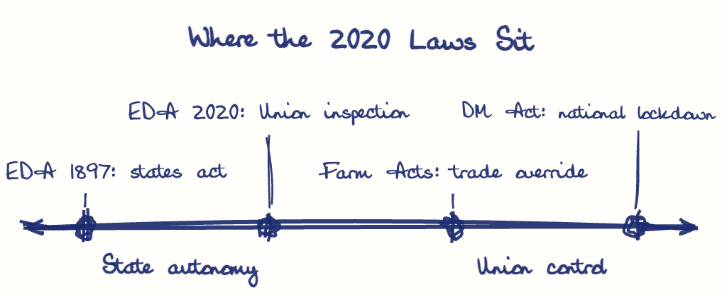
Indian constitution exhibits centralising tendencies to maintain unity and integrity of the nation. Elucidate in the perspective of the Epidemic Diseases Act, 1897; The Disaster Management Act, 2005 and recently passed Farm Acts.
In short
The Epidemic Diseases Act, the Disaster Management Act and the 2020 Farm Acts show the Constitution's centralising tilt, vital for unity in a pandemic but contested when it overrides State subjects. An NDMA order of 24 March 2020 enabled a binding 21-day national lockdown.
Model answer
Ghissu Editorial · Verified 4 Oct 2026 · 292 words
Ambedkar called India's Constitution "both unitary as well as federal according to the requirements of time and circumstances". Articles 246, 248, 256 and 352 give the Centre reserve strength, which three laws showed at work in 2020.
Pandemic Laws and Centralised Crisis Command
1. Epidemic Diseases Act, 1897: Section 2A and the 2020 amendment let the Centre inspect any bus, train, ship or aircraft, and the amendment punished violence on health workers. 2. Concurrent anchor: Inter-state spread of infectious disease is Entry 29 of the Concurrent List, justifying uniform national rules. 3. Disaster Management Act, 2005: An NDMA order of 24 March 2020 under Section 6(2)(i) enabled a binding 21-day national lockdown, though West Bengal protested central inspection teams and Kerala had to roll back its relaxations.
Competence claimed
Agriculture and markets are State subjects, but the Centre used Concurrent Entry 33 on foodstuff trade to free trade outside APMC yards.
Fiscal and process strain
Barring state market fees hit Punjab's revenue, and voice-vote passage in the Rajya Sabha prompted counter-Bills in Punjab, Rajasthan and Chhattisgarh.
Federal correction
A Supreme Court stay (January 2021) and repeal (November 2021) followed.
Consult before legislating
Use the Inter-State Council, as the Punchhi Commission urged for Concurrent subjects.
Modern epidemic law
Define Union and state roles in advance.
This model answer is indicative and the model can make mistakes; please verify key facts independently.
Practise this question
1Get the answer sheet
Sized for this question.
2Write your answer
Timed, by hand.
3Get it marked
Your score and what to fix.
This chapter in the exam
Issues & Challenges Pertaining to the Federal Structure5 questions
Asked in 4 of 14 sittings since 2013
- 2020How far do you think cooperation, competition and confrontation have shaped the nature of federation in India? Cite some recent examples to validate your answer.
- 2016Did the Government of India Act, 1935 lay down a federal constitution ? Discuss.
All 5 questions, sorted by sub-topic, with model answers and practice.
Question from the official UPSC Civil Services (Main) Examination 2020 paper. Answer written by Ghissu's engine and checked against our editorial standards. Found an error? Tell us and we correct it within 48 hours.