2014 · GS Paper 2 · Q4 · 12 marks
What do you understand by the concept freedom of speech and expression? Does it cover hate speech also? Why do the films in India stand on a slightly different plane from other forms of Expression? Discuss.
In short
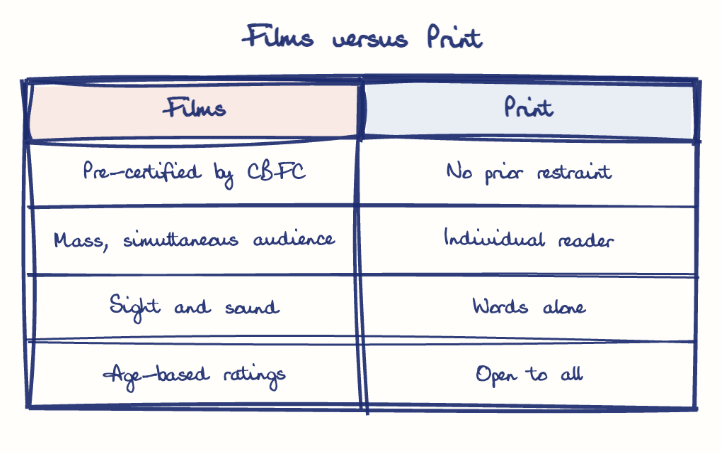
Freedom of speech under Article 19(1)(a) is broad but subject to eight reasonable restrictions, so hate speech that promotes enmity is not protected. Films stand apart because, as K.A. Abbas (1970) held, cinema stirs emotions more deeply than print, which justifies pre-certification.
Model answer
Ghissu Editorial · Verified 4 Oct 2026 · 291 words
Wide concept
It covers the press (Sakal Papers, 1962), the right to know (Raj Narain, 1975), commercial speech (Tata Press, 1995), silence (Bijoe Emmanuel, 1986) and flying the flag (Naveen Jindal, 2004).
Hate speech excluded
Speech promoting enmity between groups is punishable under Sections 153A and 295A of the IPC, upheld in Ramji Lal Modi (1957), because public order and the dignity of others are valid grounds of restriction.
A fine line
Pravasi Bhalai Sangathan (2014) asked the Law Commission to define hate speech, since merely offensive views stay protected.
Deeper impact
K.A. Abbas (1970) upheld pre-censorship because films stir emotions more deeply than print.
Proximate nexus
S. Rangarajan (1989) still required a danger as close as a spark in a powder keg before a certified film is restricted, and Bobby Art (1996) judged a film as a whole.
Prior restraint accepted
CBFC certification under the Cinematograph Act 1952 is a restraint Brij Bhushan (1950) refused for newspapers.
This model answer is indicative and the model can make mistakes; please verify key facts independently.
Practise this question
1Get the answer sheet
Sized for this question.
2Write your answer
Timed, by hand.
3Get it marked
Your score and what to fix.
This chapter in the exam
Significant Provisions — Fundamental Rights9 questions
Asked in 8 of 14 sittings since 2013
- 2026Right to privacy relating to self-identity is very dear to every human being and well protected under Article 21 of the Constitution. In this context, examine the effect of the amendment in 2026, to the Transgender Persons (Protection of Rights) Act, 2019.
- 2024Right to privacy is intrinsic to life and personal liberty and is inherently protected under Article 21 of the constitution. Explain. In this reference discuss the law relating to D.N.A. testing of child in the womb to establish paternity.
All 9 questions, sorted by sub-topic, with model answers and practice.
Question from the official UPSC Civil Services (Main) Examination 2014 paper. Answer written by Ghissu's engine and checked against our editorial standards. Found an error? Tell us and we correct it within 48 hours.