2014 · GS Paper 4 · Q13 · 20 marks
Rameshwar successfully cleared the prestigious civil services examination and was excited about the opportunity that he would get through the civil services to serve the country. However, soon after joining the services, he realized that things are not as rosy as he had imagined. He found a number of malpractices prevailing in the department assigned to him. For example, funds under various schemes and grants were being misappropriated. The official facilities were frequently being used for personal needs by the officers and staff. After some time, he noticed that the process of recruiting the staff was also not up to the mark. Prospective candidates were required to write an examination in which a lot of cheating was going on. Some candidates were provided external help in the examination. Rameshwar brought these incidents to the notice of his seniors. However, he was advised to keep his eyes, ears and mouth shut and ignore all these things which were taking place with the connivance of the higher-ups. Rameshwar felt highly disillusioned and uncomfortable. He comes to you seeking your advice. Indicate various options that you think are available in this situation. How would you help him to evaluate these options and choose the most appropriate path to be adopted?
In short
Rameshwar should neither stay silent nor quit, but gather evidence, report the malpractices in writing up the chain and approach the Central Vigilance Commission if ignored. The 2004 whistle-blower resolution, born after Satyendra Dubey's murder, protects such lawful disclosure.
Model answer
Ghissu Editorial · Verified 4 Oct 2026 · 280 words
(i) CAPITULATE [Compromised-Hybrid]
Silence protects his career but is Bystander Apathy and complicity.
(ii) EVADE [Procedural-Evasive]
A transfer brings peace but is Moral Escapism; the fraud continues.
(iii) COMPROMISE [Empathetic-Humanitarian]
Clean conduct alone leaves candidates cheated through Diffusion of Responsibility.
(iv) CONFRONT [Strict-Legal]
Going to the media breaches the Conduct Rules and alerts the culprits.
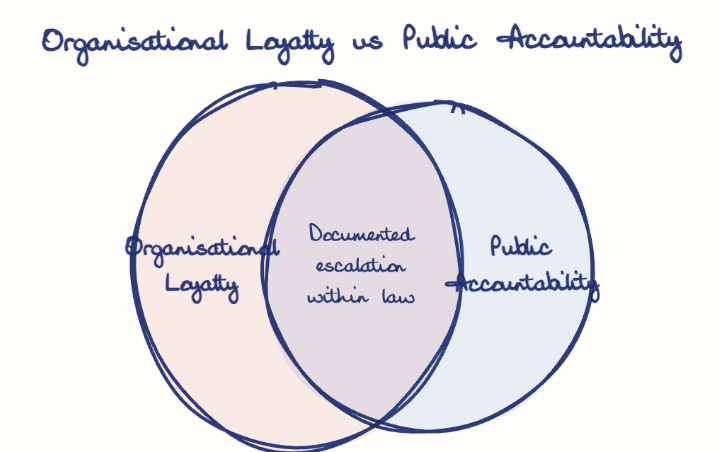
(v) RECONCILE ✓ [Balanced]
Document and escalate through lawful channels (recommended).
Record and report
Gather evidence and report in writing to the Head of Department, as T.S.R. Subramanian (2013) [case] favoured recorded over oral instructions.
Protected channel
If ignored, approach the CVC under the 2004 whistle-blower resolution born after Satyendra Dubey's [officer] murder.
Clean recruitment
Seek CCTV and outside invigilators, citing the Public Examinations Act, 2024 [current event].
This model answer is indicative and the model can make mistakes; please verify key facts independently.
Practise this question
1Get the answer sheet
Sized for this question.
2Write your answer
Timed, by hand.
3Get it marked
Your score and what to fix.
This chapter in the exam
Integrity Under Pressure7 questions
Asked in 6 of 14 sittings since 2013
- 2025Subash is Secretary, PWD in the State Government. He is a senior officer, known for his competence, integrity and dedication to work. He enjoys the trust and confidence of Minister Incharge of PWD and Programme Implementation. As a part of his job profile, he is responsible for policy formulation, execution of projects relating to infrastructure initiatives in the State. Besides, he oversees the technical and administrative aspects relating to planning, designing and construction etc. Subash's Minister is an important Minister in the state and significant growth in urban infrastructure development and road network has been registered during his tenure. He is very keen for launching of ambitious road construction project in the near future. Subash is in regular touch with the Minister and is working various modalities of road construction project. Regular meetings, interactions and presentations are made by him to the Minister before a formal public announcement of the project is made by the Minister. Subash's only son Vikas is in real estate business. His son from his own sources is aware that a mega road project is on the anvil and announcement in this regard is expected anytime. He is very keen to know from his father the exact location of the upcoming project. He knows that there would be quantum jump in the prices of land in the vicinity. Buying land at this stage at cheaper prices would pay him rich dividends. He is pleading with him (his father) day in and day out to share him location of the proposed project. He assured him that he would handle the matter discretely as it would not attract any adverse notice as he in the normal course, keeps on buying land as a part of his business. He feels pressurised because of constant pleadings by his son. Another significant aspect of the matter pertained to the extra/undue interest in the above project by the Minister PWD. His nephew was also having big infrastructure project company. In fact, the Minister has also introduced his nephew to him and indicated to him to take care of his nephew's business interest in the forthcoming project. The Minister encouraged him to act fast in the matter as early announcement and execution of mega road project would enhance his status in the party and public life. (a) Discuss the ethical issues involved in the case. (b) Critically examine the options available to Subash in the above situation. (c) Which of the above would be most appropriate and why?
- 2022Ramesh is a State Civil Services Officer who got the opportunity of getting posted to the capital of a border State after rendering 20 years of service. Ramesh's mother has recently been detected cancer and has been admitted in the leading cancer hospital of the city. His two adolescent children have also got admission in one of the best public schools of the town. After settling down in his appointment as Director in the Home Department of the State, Ramesh got confidential report through intelligence sources that illegal migrants are infiltrating in the State from the neighbouring country. He decided to personally carry out surprise check of the border posts along with his Home Department team. To his surprise, he caught red-handed two families of 12 members infiltrated with the connivance of the security personnel at the border posts. On further inquiry and investigation, it was found that after the migrants from neighbouring country infiltrate, their documentation like Aadhaar Card, Ration Card and Voter Card are also forged and they are made to settle down in a particular area of the State. Ramesh prepared the detailed and comprehensive report and submitted to the Additional Secretary of the State. However, he has summoned by the Additional Home Secretary after a week and was instructed to withdraw the report. The Additional Home Secretary informed Ramesh that the report submitted by him has not been appreciated by the higher authorities. He further cautioned him that if he fails to withdraw the confidential report, he will not only be posted out from the prestigious appointment from the State capital but his further promotion which is due in near future will also get in jeopardy. (a) What are the options available to Ramesh as the Director of the Home Department of the bordering State? (b) What option should Ramesh adopt and why? (c) Critically evaluate each of the options. (d) What are the ethical dilemmas being faced by Ramesh? (e) What policy measures would you suggest to combat the menace of infiltration of illegal migrants from the neighbouring country?
All 7 questions, sorted by sub-topic, with model answers and practice.
Question from the official UPSC Civil Services (Main) Examination 2014 paper. Answer written by Ghissu's engine and checked against our editorial standards. Found an error? Tell us and we correct it within 48 hours.