2014 · GS Paper 4 · Q7 · 10 marks
What does 'accountability' mean in the context of public service? What measures can be adopted to ensure individual and collective accountability of public servants?
In short
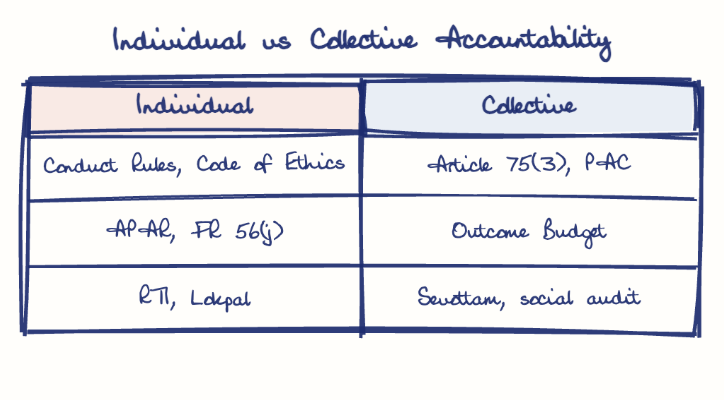
Accountability in public service means an official must explain and justify decisions and accept their consequences, ensured individually through codes, appraisal and sanctions and collectively through legislative, audit and citizen scrutiny. Article 75(3) makes the Council of Ministers collectively responsible to the Lok Sabha.
Model answer
Ghissu Editorial · Verified 4 Oct 2026 · 282 words
Answerability and enforceability
An officer must give reasons for an action and face a sanction for a wrong one. Satish Dhawan, as ISRO chairman, publicly owned the SLV-3 failure of 1979.
Outcomes over procedure
A District Collector answers for whether a health centre treats patients, not only whether its funds were released.
Codes that define duty
The All India Services (Conduct) Rules, 1968, with the Code of Ethics the Second ARC (2007) recommended, set clear expectations.
Performance-linked appraisal
A transparent APAR with measurable targets, and Fundamental Rule 56(j) for proven non-performers, ties career to conduct.
Traceable decisions and sanctions
File notings, the RTI Act, 2005, the Lokpal Act, 2013 and the Whistle Blowers Protection Act, 2014 expose, punish and protect.
Legislative scrutiny
Article 75(3) makes the Council of Ministers collectively responsible to the Lok Sabha, and the Public Accounts Committee examines CAG audits.
Outcome budgeting and charters
The Outcome Budget since 2005-06, Sevottam citizen charters and CPGRAMS judge an office by results.
Social audit
Section 17 of MGNREGA mandates gram sabha audits of every scheme work.
This model answer is indicative and the model can make mistakes; please verify key facts independently.
Practise this question
1Get the answer sheet
Sized for this question.
2Write your answer
Timed, by hand.
3Get it marked
Your score and what to fix.
This chapter in the exam
Accountability and ethical governance7 questions
Asked in 6 of 14 sittings since 2013
- 2025"Constitutional morality is not a natural sentiment but a product of civil education and adherence of the rule of law." Examine the significance of constitutional morality for public servant highlighting the role in promoting good governance and ensuring accountability in public administration.
- 2022What do you understand by the term 'good governance'? How far recent initiatives in terms of e-Governance steps taken by the State have helped the beneficiaries? Discuss with suitable examples.
All 7 questions, sorted by sub-topic, with model answers and practice.
Question from the official UPSC Civil Services (Main) Examination 2014 paper. Answer written by Ghissu's engine and checked against our editorial standards. Found an error? Tell us and we correct it within 48 hours.