2025 · GS Paper 4 · Q1(b) · 10 marks
"Constitutional morality is not a natural sentiment but a product of civil education and adherence of the rule of law." Examine the significance of constitutional morality for public servant highlighting the role in promoting good governance and ensuring accountability in public administration.
In short
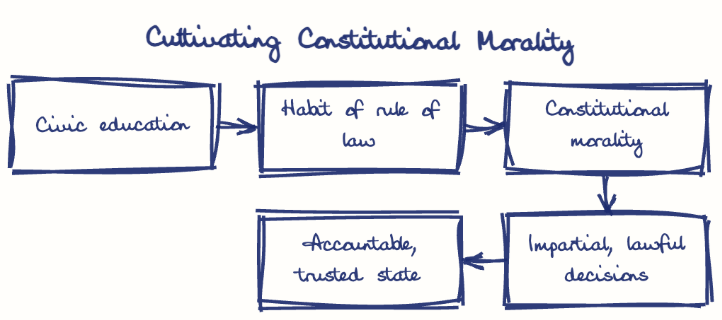
Constitutional morality, which Ambedkar said must be cultivated, makes public servants place constitutional values and the rule of law above personal or political pressure, promoting impartial good governance and accountability. T.S.R. Subramanian (2013) urged officers to record oral instructions, guarding against Emergency-era obedience to unlawful orders.
Model answer
Ghissu Editorial · Verified 4 Oct 2026 · 272 words
Cultivated through training
Article 51A(a) asks every citizen to abide by the Constitution, and Mission Karmayogi (2020) trains officers in rule-based, citizen-centric conduct.
Rule of law over whim
E.P. Royappa (1974) held arbitrariness to be the antithesis of equality under Article 14, so every decision must rest on law and reasons.
Impartiality against prejudice
Shakti Vahini (2018) directed district officials to protect inter-caste couples from khap diktats, placing constitutional values above community sentiment.
Answerability within legal forms
The RTI Act 2005 and reasoned written orders keep power "subject only to definite legal control".
Refusing unlawful orders
T.S.R. Subramanian (2013) urged officers to record oral instructions, guarding against the obedience the Shah Commission (1978) found during the Emergency.
Open to scrutiny
Social audits under Section 17 of MGNREGA let citizens question officials publicly, the open censure of public acts that Grote paired with obedience.
This model answer is indicative and the model can make mistakes; please verify key facts independently.
Practise this question
1Get the answer sheet
Sized for this question.
2Write your answer
Timed, by hand.
3Get it marked
Your score and what to fix.
This chapter in the exam
Accountability and ethical governance7 questions
Asked in 6 of 14 sittings since 2013
- 2022What do you understand by the term 'good governance'? How far recent initiatives in terms of e-Governance steps taken by the State have helped the beneficiaries? Discuss with suitable examples.
- 2022Write short notes on the following in 30 words each: Constitutional morality
All 7 questions, sorted by sub-topic, with model answers and practice.
Question from the official UPSC Civil Services (Main) Examination 2025 paper. Answer written by Ghissu's engine and checked against our editorial standards. Found an error? Tell us and we correct it within 48 hours.