2022 · GS Paper 4 · Q4(a) · 10 marks
What do you understand by the term 'good governance'? How far recent initiatives in terms of e-Governance steps taken by the State have helped the beneficiaries? Discuss with suitable examples.
In short
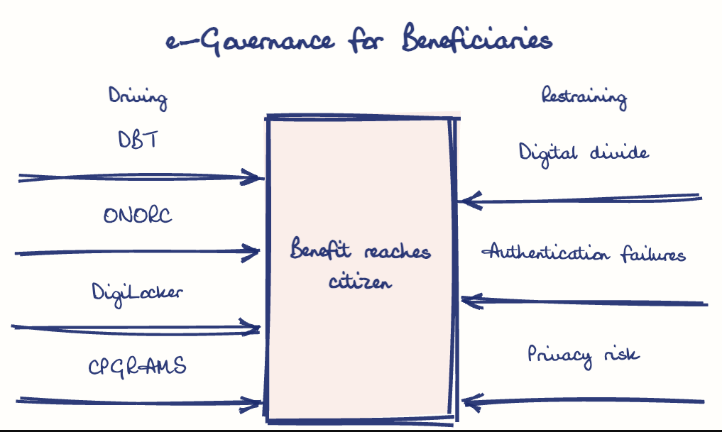
Good governance is participatory, transparent, accountable and equitable rule of law, and e-Governance has largely but not fully delivered it to beneficiaries through DBT, ration portability and digital records while exclusion persists. The Agriculture Ministry (2023) reported that removing 1.72 crore ineligible PM-Kisan names saved about ₹10,000 crore in a year.
Model answer
Ghissu Editorial · Verified 4 Oct 2026 · 280 words
Leakage-free transfers
DBT on the JAM trinity pays citizens without middlemen; the Agriculture Ministry (2023) reported that removing 1.72 crore ineligible PM-Kisan names saved about ₹10,000 crore in a year.
Portability
One Nation One Ration Card, live in all States and UTs by 2022, let migrant workers draw rations wherever they work, a lifeline during and after the pandemic.
Access and voice
DigiLocker, UMANG, more than 36.9 crore Ayushman Bharat cards (Health Ministry, March 2025) and CPGRAMS cut paperwork, bribes and untraceable delay.
Exclusion by design
Santoshi Kumari's 2017 death in Simdega, Jharkhand, after her ration card was cancelled for want of Aadhaar seeding, showed a technical rule overriding the right to food.
Digital divide
Elderly and rural citizens still rely on intermediaries at Common Service Centres, so the poorest often pay a new kind of middleman.
Privacy
Puttaswamy (2018) upheld Aadhaar for welfare but barred compulsory private use, so efficiency cannot erode Dignity-as-Floor.
This model answer is indicative and the model can make mistakes; please verify key facts independently.
Practise this question
1Get the answer sheet
Sized for this question.
2Write your answer
Timed, by hand.
3Get it marked
Your score and what to fix.
This chapter in the exam
Accountability and ethical governance7 questions
Asked in 6 of 14 sittings since 2013
- 2025"Constitutional morality is not a natural sentiment but a product of civil education and adherence of the rule of law." Examine the significance of constitutional morality for public servant highlighting the role in promoting good governance and ensuring accountability in public administration.
- 2022Write short notes on the following in 30 words each: Constitutional morality
All 7 questions, sorted by sub-topic, with model answers and practice.
Question from the official UPSC Civil Services (Main) Examination 2022 paper. Answer written by Ghissu's engine and checked against our editorial standards. Found an error? Tell us and we correct it within 48 hours.