2014 · GS Paper 4 · Q6 · 10 marks
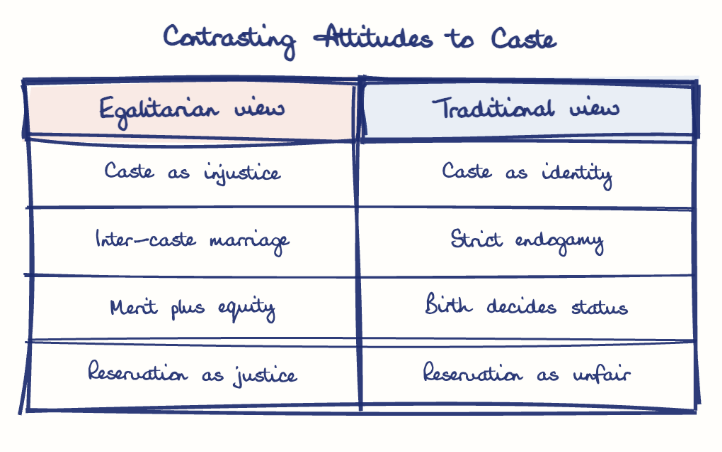
What factors affect the formation of a person's attitude towards social problems? In our society, contrasting attitudes are prevalent about many social problems. What contrasting attitudes do you notice about the caste system in our society? How do you explain the existence of these contrasting attitudes?
In short
Attitudes to social problems form through family socialisation, education, direct experience and self-interest, which is why Indians hold opposed attitudes to caste, rejecting it in belief while retaining it in practice. The IHDS-II survey (2011-12) found about 27% of households admitting some form of untouchability.
Model answer
Ghissu Editorial · Verified 4 Oct 2026 · 286 words
Family and education
The family plants the first beliefs about purity or gender roles, while schooling and diverse peers can challenge them, as education sharpened Ambedkar's critique of caste.
Experience and interest
A victim and a beneficiary of privilege read a problem differently, and Daniel Katz's functional theory shows attitudes also protect one's status, with media and law reshaping them.
Said versus done
Many reject caste in public yet practise it privately; the IHDS-II survey (2011-12) found about 27% of households admitting some untouchability, and only around 5% of marriages were inter-caste.
Stigma versus ladder
Caste is condemned yet used, as the Patidar, Jat and Maratha quota agitations of 2015-16 showed.
Belief and feeling diverge
Articles 15 and 17 and education change beliefs fast, but community emotions change slowly, producing Festinger's cognitive dissonance.
Interest and politics
M.N. Srinivas's dominant caste and Rajni Kothari's politicisation of caste show caste as a resource for votes and jobs, defended by those it benefits.
This model answer is indicative and the model can make mistakes; please verify key facts independently.
Practise this question
1Get the answer sheet
Sized for this question.
2Write your answer
Timed, by hand.
3Get it marked
Your score and what to fix.
This chapter in the exam
Attitude — Content, structure, function4 questions
Asked in 3 of 14 sittings since 2013
- 2021Attitude is an important component that goes as input in the development of human being. How to build a suitable attitude needed for a public servant?
- 2015Two different kinds of attitudes exhibited by public servants towards their work have been identified as the bureaucratic attitude and the democratic attitude. Distinguish between these two terms and write their merits and demerits.
All 4 questions, sorted by sub-topic, with model answers and practice.
Question from the official UPSC Civil Services (Main) Examination 2014 paper. Answer written by Ghissu's engine and checked against our editorial standards. Found an error? Tell us and we correct it within 48 hours.