2015 · GS Paper 4 · Q5(a) · 5 marks
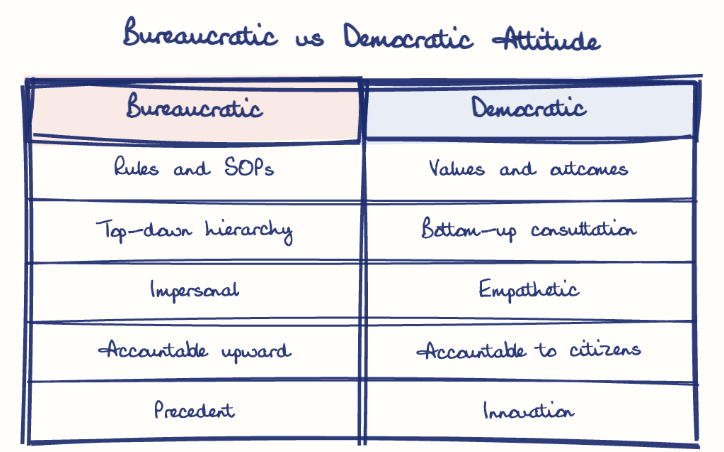
Two different kinds of attitudes exhibited by public servants towards their work have been identified as the bureaucratic attitude and the democratic attitude. Distinguish between these two terms and write their merits and demerits.
In short
The bureaucratic attitude values rules, hierarchy and impersonality, ensuring impartiality but risking red tape, while the democratic attitude values participation and responsiveness, building legitimacy but risking delay and populism. The 2nd ARC's twelfth report (2009) called citizen-centric administration the heart of governance.
Model answer
Ghissu Editorial · Verified 4 Oct 2026 · 285 words
Bureaucratic attitude
An orientation of strict adherence to rules, procedure, hierarchy and impersonality, with files and precedents as the measure of correct action.
Democratic attitude
An orientation of participation, transparency and responsiveness, treating citizens as stakeholders and judging action by its outcome for them.
Bureaucratic merits
Rules ensure impartiality, predictability and resistance to pressure, as T.N. Seshan's firm enforcement of the Model Code of Conduct in the 1990s showed by restoring public trust in elections.
Bureaucratic demerits
Merton's goal displacement turns rules into ends, producing red tape, colonial aloofness and citizens shuttling between offices for a pension or a certificate.
Democratic merits
Participation builds legitimacy; MGNREGA social audits through Andhra Pradesh's SSAAT exposed misused funds, and Armstrong Pame's crowdfunded People's Road (2012) mobilised citizens where procedure stalled.
Democratic demerits
Long consultation delays decisions, invites populism and lets vocal groups capture the agenda, while eagerness to please may dilute neutrality.
This model answer is indicative and the model can make mistakes; please verify key facts independently.
Practise this question
1Get the answer sheet
Sized for this question.
2Write your answer
Timed, by hand.
3Get it marked
Your score and what to fix.
This chapter in the exam
Attitude — Content, structure, function4 questions
Asked in 3 of 14 sittings since 2013
- 2021Attitude is an important component that goes as input in the development of human being. How to build a suitable attitude needed for a public servant?
- 2015Two different kinds of attitudes exhibited by public servants towards their work have been identified as the bureaucratic attitude and the democratic attitude. Is it possible to balance the two to create a better administration for the faster development of our country?
All 4 questions, sorted by sub-topic, with model answers and practice.
Question from the official UPSC Civil Services (Main) Examination 2015 paper. Answer written by Ghissu's engine and checked against our editorial standards. Found an error? Tell us and we correct it within 48 hours.