2015 · GS Paper 1 · Q3 · 12 marks
How different would have been the achievement of Indian independence without Mahatma Gandhi? Discuss.
In short
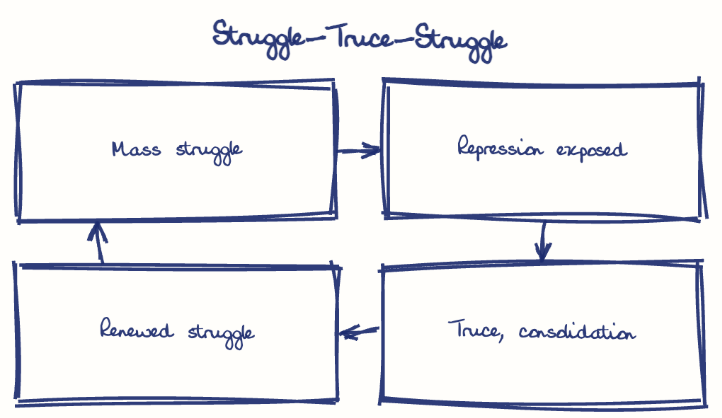
Without Gandhi, India would probably still have won independence because the Second World War and the Raj's exhaustion made empire untenable, but later, more violently and as a narrower elite settlement. His satyagraha and Struggle-Truce-Struggle rhythm gave the movement its mass, non-violent and inclusive base.
Model answer
Ghissu Editorial · Verified 4 Oct 2026 · 266 words
From elite to masses
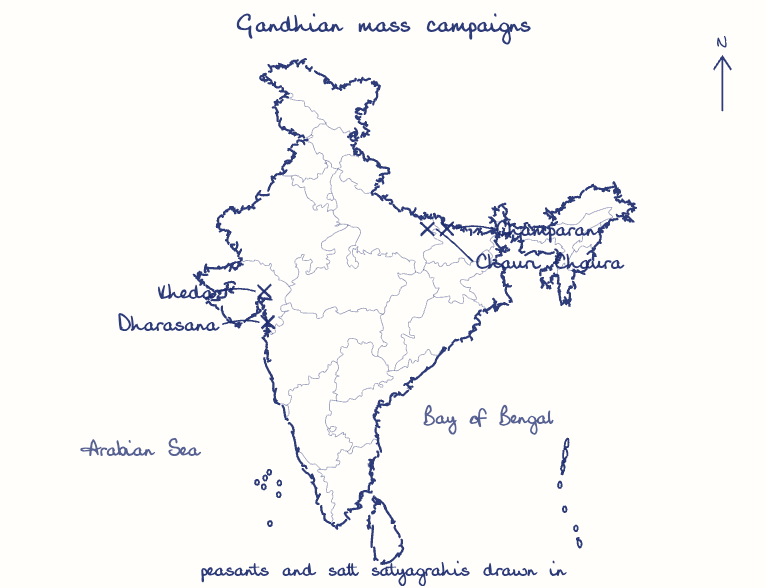
Champaran (1917) and the Non-Cooperation Movement (1920-22) brought peasants, workers and women into national politics.
A method for the unarmed
Satyagraha let millions resist, and repression at Dharasana (1930) cost the Raj its moral legitimacy.
A broader nation
The Khilafat alliance, the Harijan Sevak Sangh (1932) and khadi tied communities, castes and villages into one national idea.
Slower and narrower
Moderate petitions had won only limited councils and the Extremist surge faded after 1908, pointing to a later, elite settlement.
More violent
Revolutionary groups like the HSRA lacked a mass base, and Chauri Chaura (1922) showed how mass anger could turn violent without restraint.
Structural forces
The Second World War, the INA trials (1945) and the RIN mutiny (1946) would still have pushed Britain out.
A different republic
Without Gandhi's moral politics, the anti-untouchability drive and the rooting of democracy in villages would have been far weaker.
This model answer is indicative and the model can make mistakes; please verify key facts independently.
Practise this question
1Get the answer sheet
Sized for this question.
2Write your answer
Timed, by hand.
3Get it marked
Your score and what to fix.
This chapter in the exam
Role of Masses and Personalities13 questions
Asked in 8 of 14 sittings since 2013
- 2026The significance of the Gandhian movements lay in the masses they mobilized. Elucidate.
- 2021Bring out the constructive programmes of Mahatma Gandhi during Non-Cooperation Movement and Civil Disobedience Movement.
All 13 questions, sorted by sub-topic, with model answers and practice.
Question from the official UPSC Civil Services (Main) Examination 2015 paper. Answer written by Ghissu's engine and checked against our editorial standards. Found an error? Tell us and we correct it within 48 hours.