2021 · GS Paper 1 · Q12 · 15 marks
Bring out the constructive programmes of Mahatma Gandhi during Non-Cooperation Movement and Civil Disobedience Movement.
In short
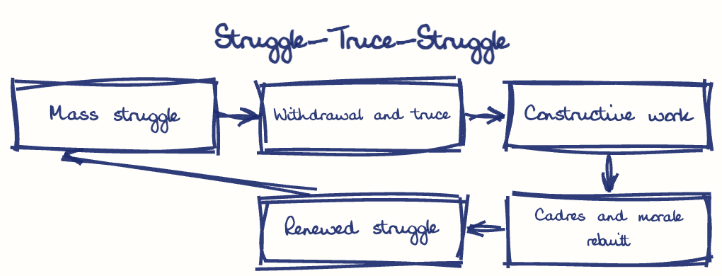
During Non-Cooperation and Civil Disobedience, Gandhi paired boycott with constructive work in khadi, national education, prohibition, Hindu-Muslim unity and the removal of untouchability. The Bezwada programme of 1921 and the Harijan Sevak Sangh of 1932 show how this work sustained the struggle-truce-struggle strategy.
Model answer
Ghissu Editorial · Verified 4 Oct 2026 · 270 words
Bezwada targets
The AICC at Bezwada (March 1921) sought one crore members, one crore rupees for the Tilak Swaraj Fund and twenty lakh charkhas.
Khadi and national education
Khadi gave boycott a positive face, while Gujarat Vidyapith, Jamia Millia Islamia and Kashi Vidyapith trained a nationalist cadre.
Social reform
Anti-untouchability work, liquor picketing, panchayat arbitration and Hindu-Muslim unity became central after the Bardoli resolution (1922).
Salt, khadi and prohibition
Salt-making at Dandi, khadi and women's picketing of liquor and cloth shops joined self-reliance to boycott; total prohibition headed Gandhi's eleven demands of 1930.
Harijan uplift
After the Poona Pact, the Harijan Sevak Sangh (1932), the weekly Harijan and the 1933-34 tour targeted untouchability and temple entry.
Village industries
The All India Village Industries Association (1934) and later the Wardha scheme (1937) institutionalised the work.
Unfinished agenda
Article 17 abolished untouchability, but social equality, decentralised livelihoods and education with work remain tasks for today.
This model answer is indicative and the model can make mistakes; please verify key facts independently.
Practise this question
1Get the answer sheet
Sized for this question.
2Write your answer
Timed, by hand.
3Get it marked
Your score and what to fix.
This chapter in the exam
Role of Masses and Personalities13 questions
Asked in 8 of 14 sittings since 2013
- 2026The significance of the Gandhian movements lay in the masses they mobilized. Elucidate.
- 2020Evaluate the policies of Lord Curzon and their long term implications on the national movements.
All 13 questions, sorted by sub-topic, with model answers and practice.
Question from the official UPSC Civil Services (Main) Examination 2021 paper. Answer written by Ghissu's engine and checked against our editorial standards. Found an error? Tell us and we correct it within 48 hours.