2026 · GS Paper 1 · Q3 · 10 marks
The significance of the Gandhian movements lay in the masses they mobilized. Elucidate.
In short
The Gandhian movements were significant chiefly because they turned nationalism from an elite concern into a mass struggle of peasants, workers, women and students, building pressure and a habit of democracy. Over 90,000 people were jailed during the 1930 Civil Disobedience campaign alone.
Model answer
Ghissu Editorial · Verified 4 Oct 2026 · 283 words
Local grievance first
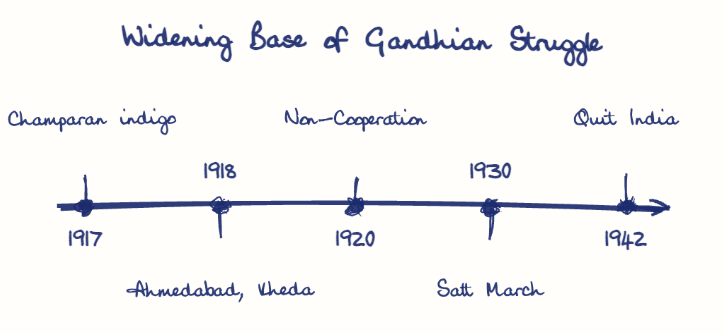
Starting from the tinkathia system, mill wages and land revenue, Gandhi made nationalism the peasant's and worker's own cause.
Simple symbols
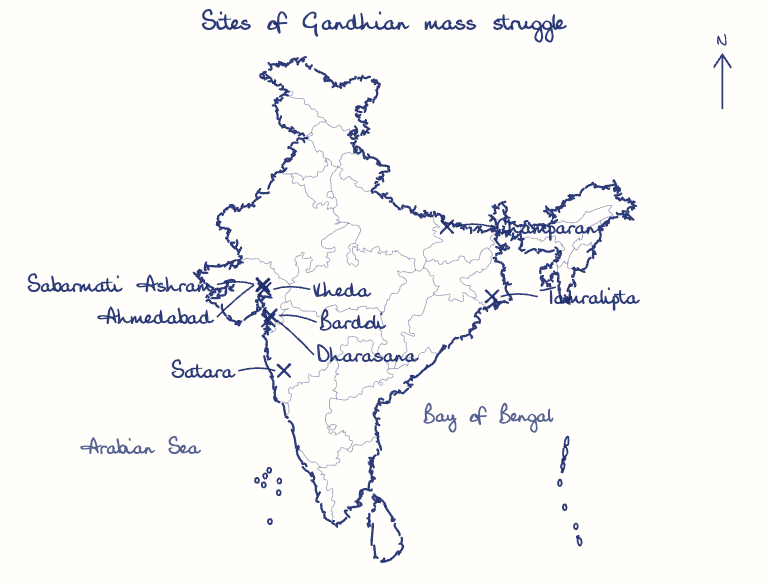
Salt, the charkha and khadi made swaraj an act anyone could perform; the 78 Dandi marchers of 1930 grew into a campaign in which over 90,000 were jailed.
Organisation for all
The Nagpur session (1920) created linguistic provincial committees and a four-anna membership, while women, Khudai Khidmatgars and Khilafatists joined in large numbers.
Mass nationalism
The Congress became a mass movement, demolishing Dufferin's jibe that it spoke for a "microscopic minority".
Moral and economic pressure
Dharasana (1930) exposed colonial force to the world, and foreign cloth imports fell from Rs 102 crore in 1920-21 to Rs 57 crore in 1921-22.
School of democracy
Parallel governments at Satara and Tamluk (1942) showed ordinary people learning self-rule, preparing the ground for universal adult franchise in 1950.
This model answer is indicative and the model can make mistakes; please verify key facts independently.
Practise this question
1Get the answer sheet
Sized for this question.
2Write your answer
Timed, by hand.
3Get it marked
Your score and what to fix.
This chapter in the exam
Role of Masses and Personalities13 questions
Asked in 8 of 14 sittings since 2013
- 2021Bring out the constructive programmes of Mahatma Gandhi during Non-Cooperation Movement and Civil Disobedience Movement.
- 2020Evaluate the policies of Lord Curzon and their long term implications on the national movements.
All 13 questions, sorted by sub-topic, with model answers and practice.
Question from the official UPSC Civil Services (Main) Examination 2026 paper. Answer written by Ghissu's engine and checked against our editorial standards. Found an error? Tell us and we correct it within 48 hours.