2015 · GS Paper 1 · Q4 · 12 marks
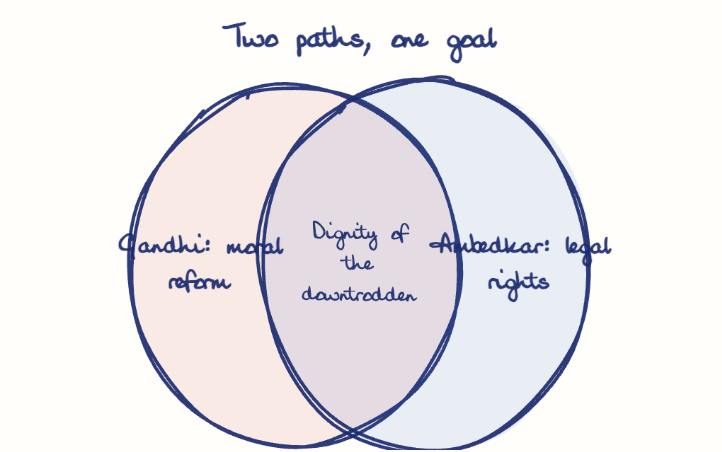
Mahatma Gandhi and Dr. B.R. Ambedkar, despite having divergent approaches and strategies, had a common goal of amelioration of the downtrodden. Elucidate.
In short
Gandhi sought to end untouchability through moral reform of caste Hindus, while Ambedkar sought the annihilation of caste through law, representation and self-assertion, yet both aimed at the dignity of the downtrodden. Their clash ended in the Poona Pact of 1932, whose reserved seats the Constitution carried forward.
Model answer
Ghissu Editorial · Verified 4 Oct 2026 · 271 words
Diagnosis of caste
Gandhi defended varna and attacked only untouchability, while Ambedkar's Annihilation of Caste (1936) demanded that caste itself go.
Moral reform versus rights
Gandhi sought a change of heart through fasts and the Harijan Sevak Sangh (1932); Ambedkar relied on law and self-assertion, as in the Mahad Satyagraha (1927) for access to the Chavdar tank.
Representation
Ambedkar's demand for separate electorates clashed with Gandhi's fear of dividing Hinduism, ending in 148 reserved seats in joint electorates.
Village and religion
Gandhi idealised the self-reliant village and reform within Hinduism, while Ambedkar called the village "a sink of localism" and embraced Buddhism in 1956.
War on untouchability
Gandhi backed the Vaikom Satyagraha (1924-25), Ambedkar fought for access to tanks and temples, and Article 17 abolished untouchability.
Convergence
By the 1940s Gandhi blessed only inter-caste marriages, while Ambedkar used the reserved seats as a lever for political voice.
Constitutional synthesis
Articles 330 and 332 carried the Pact forward, and Article 46 echoed Gandhi's constructive concern for the weaker sections.
This model answer is indicative and the model can make mistakes; please verify key facts independently.
Practise this question
1Get the answer sheet
Sized for this question.
2Write your answer
Timed, by hand.
3Get it marked
Your score and what to fix.
This chapter in the exam
Role of Masses and Personalities13 questions
Asked in 8 of 14 sittings since 2013
- 2026The significance of the Gandhian movements lay in the masses they mobilized. Elucidate.
- 2021Bring out the constructive programmes of Mahatma Gandhi during Non-Cooperation Movement and Civil Disobedience Movement.
All 13 questions, sorted by sub-topic, with model answers and practice.
Question from the official UPSC Civil Services (Main) Examination 2015 paper. Answer written by Ghissu's engine and checked against our editorial standards. Found an error? Tell us and we correct it within 48 hours.