2015 · GS Paper 1 · Q1 · 12 marks
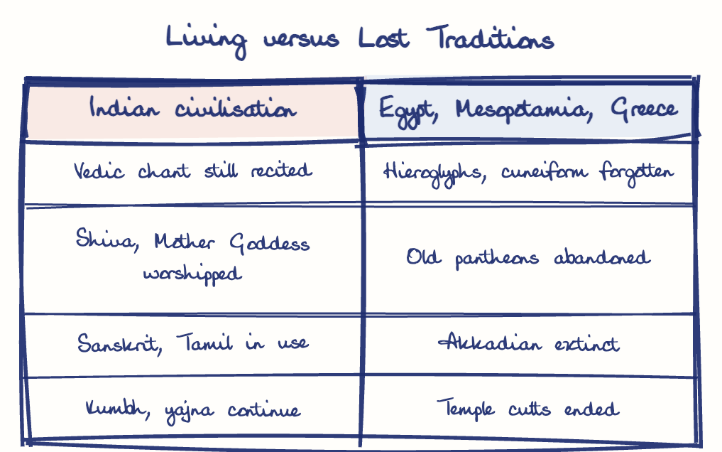
The ancient civilization in Indian sub-continent differed from those of Egypt, Mesopotamia and Greece in that its culture and traditions have been preserved without a breakdown to the present day. Comment.
In short
Unlike Egypt, Mesopotamia and Greece, whose gods, scripts and rituals ceased to be lived, India still recites, worships and practises much of its ancient inheritance, though through ruptures and synthesis. Vedic chanting, recognised by UNESCO in 2008, is still recited after more than three thousand years.
Model answer
Ghissu Editorial · Verified 4 Oct 2026 · 307 words
Harappan roots
Kalibangan's criss-cross ploughed field resembles a sowing pattern still used in Rajasthan, John Marshall read the Pashupati seal as proto-Shiva, and Mother Goddess and pipal worship survive in village shrines.
Living texts
The Vedas passed orally with exact recitation across generations, and Tamil carries a literary line from the Sangam poems to the present, unlike Akkadian.
Rituals
The saptapadi of marriage follows the Grihya Sutras, and the Kumbh Mela (UNESCO, 2017) continues an ancient pilgrimage.
Lost cities and scripts
Indus cities and script were lost after about 1900 BCE, and Brahmi had to be deciphered by James Prinsep in 1837.
Faiths that faded
Buddhism almost vanished from its homeland after the twelfth century.
Others not wholly broken
Greek has been spoken for three millennia, and Egyptian survives as liturgical Coptic, so the contrast is one of degree.
Continuity through change
Indian traditions lasted by absorbing Greek, Central Asian and Islamic influences, so continuity means adaptation.
This model answer is indicative and the model can make mistakes; please verify key facts independently.
Practise this question
1Get the answer sheet
Sized for this question.
2Write your answer
Timed, by hand.
3Get it marked
Your score and what to fix.
This chapter in the exam
Indian Culture - Ancient Times8 questions
Asked in 6 of 14 sittings since 2013
- 2026Analyze the importance of Ashokan inscriptions for reconstructing Mauryan history.
- 2024Underline the changes in the field of society and economy from the Rig Vedic to the later Vedic period.
All 8 questions, sorted by sub-topic, with model answers and practice.
Question from the official UPSC Civil Services (Main) Examination 2015 paper. Answer written by Ghissu's engine and checked against our editorial standards. Found an error? Tell us and we correct it within 48 hours.