2026 · GS Paper 1 · Q1 · 10 marks
Analyze the importance of Ashokan inscriptions for reconstructing Mauryan history.
In short
Ashokan inscriptions are the backbone of Mauryan history, mapping the empire's extent, dating the reign and recording its administration, welfare and dhamma. Rock Edict XIII's account of the Kalinga war shows their value, though as royal propaganda they need corroboration from the Arthashastra and Megasthenes.
Model answer
Ghissu Editorial · Verified 4 Oct 2026 · 262 words

Extent of empire
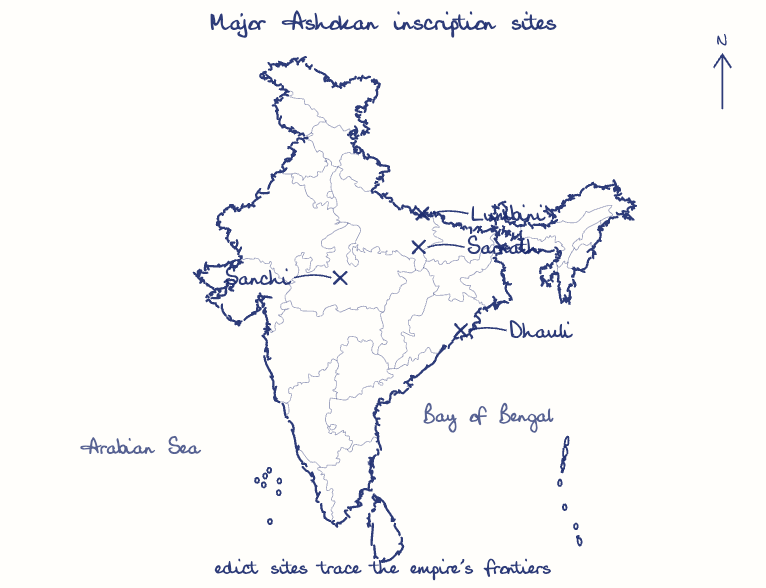
Edicts from Kandahar in Greek and Aramaic to Erragudi in the south, and from Shahbazgarhi in Kharosthi to Dhauli in Odisha, map the empire.
Chronology and Kalinga
Rock Edict XIII names Hellenistic kings like Antiochus II, dating the reign, and records 1,00,000 killed in Kalinga and Ashoka's turn to dhammavijaya.
Administration
The edicts name rajukas and pradeshikas and create dhamma mahamattas, while the Separate Kalinga Edicts call all men the king's children.
Welfare and religion
Rock Edict II records medical care and wells, the Lumbini pillar cuts the village's tax to one-eighth, and Rock Edict XII urges respect for all sects.
Royal self-projection
The edicts are the king's propaganda; Rock Edict XIII is left out at Dhauli and Jaugada in Kalinga itself, and they are silent on trade and successors.
Corroboration
Romila Thapar reads dhamma as social policy, tested against the Arthashastra, Megasthenes' Indica and the Sri Lankan chronicles.
This model answer is indicative and the model can make mistakes; please verify key facts independently.
Practise this question
1Get the answer sheet
Sized for this question.
2Write your answer
Timed, by hand.
3Get it marked
Your score and what to fix.
This chapter in the exam
Indian Culture - Ancient Times8 questions
Asked in 6 of 14 sittings since 2013
- 2024Underline the changes in the field of society and economy from the Rig Vedic to the later Vedic period.
- 2023What are the main features of Vedic society and religion? Do you think some of the features are still prevailing in Indian society?
All 8 questions, sorted by sub-topic, with model answers and practice.
Question from the official UPSC Civil Services (Main) Examination 2026 paper. Answer written by Ghissu's engine and checked against our editorial standards. Found an error? Tell us and we correct it within 48 hours.