2015 · GS Paper 1 · Q6 · 12 marks
Why did the industrial revolution first occur in England? Discuss the quality of life of the people there during the industrialization. How does it compare with that in India at present?
In short
England industrialised first because colonial capital, labour freed by enclosures, adjacent coal and iron, and inventive institutions converged, though its workers endured child labour, slums and early deaths. Edwin Chadwick's 1842 report put the average age at death of Manchester labourers at just 17.
Model answer
Ghissu Editorial · Verified 4 Oct 2026 · 312 words
England became the "workshop of the world" by the mid-nineteenth century through a rare convergence of resources, capital and institutions, at a human cost Friedrich Engels recorded in 1845.
Why England Industrialised First
1. Capital and markets: Atlantic trade and colonies such as Bengal after Plassey (1757) financed factories and assured markets. 2. Labour and food: The Agricultural Revolution and the Enclosure Acts pushed landless labourers into towns. 3. Coal, iron and inventions: Adjacent coal and iron, canals, and inventions like Watt's steam engine, backed by stability after 1688, made machines profitable.
Exploitative work
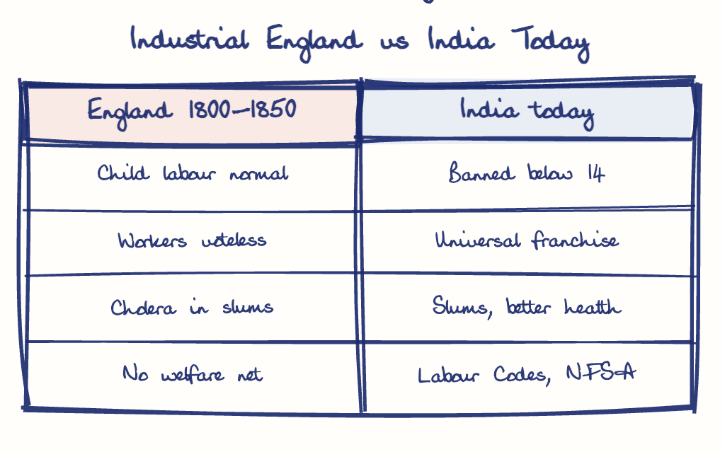
Children worked 12 to 14 hour days until the Factory Act of 1833 barred under-nines from textile mills.
Squalid cities
Chadwick's 1842 report put the average age at death of Manchester labourers at 17, amid cholera in 1832 and 1848.
Delayed gains
Real wages lagged until about 1840, the "Engels' pause", before Chartism and the Ten Hours Act of 1847.
Better safeguards
The Child Labour Amendment Act of 2016, universal franchise and the Labour Codes in force since November 2025 protect Indian workers far better.
Old problems persist
Over 30 crore unorganised workers on the e-Shram portal, slums like Dharavi and pollution in Ennore echo England's costs.
This model answer is indicative and the model can make mistakes; please verify key facts independently.
Practise this question
1Get the answer sheet
Sized for this question.
2Write your answer
Timed, by hand.
3Get it marked
Your score and what to fix.
This chapter in the exam
Industrial Revolution3 questions
Asked in 3 of 14 sittings since 2013
Question from the official UPSC Civil Services (Main) Examination 2015 paper. Answer written by Ghissu's engine and checked against our editorial standards. Found an error? Tell us and we correct it within 48 hours.