2013 · GS Paper 1 · Q11 · 10 marks
‘Latecomer’ Industrial Revolution in Japan in involved certain factors that were markedly different from what West had experienced. Analyze.
In short
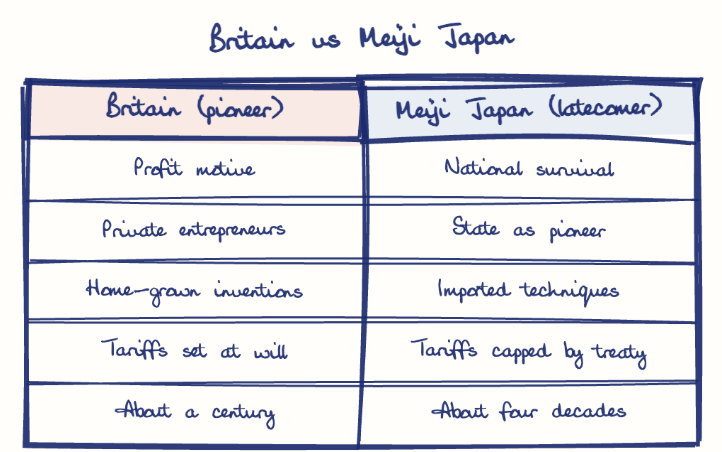
Japan's latecomer industrialisation differed from the West's because the state, not private entrepreneurs, led it for national survival, with peasant taxes, borrowed technology and zaibatsu capital. The Land Tax Reform of 1873 and state factories such as the Tomioka Silk Mill (1872) show this state-driven path.
Model answer
Ghissu Editorial · Verified 4 Oct 2026 · 301 words
State as entrepreneur
The government built the Tomioka Silk Mill and the Tokyo-Yokohama railway in 1872, then sold most enterprises to private buyers in the 1880s.
Capital from the peasantry
Lacking colonies, Japan funded industry through the Land Tax Reform of 1873, and the 1895 Chinese indemnity later helped build the Yawata Steel Works (1901).
Borrowed technology
The Iwakura Mission (1871-73) and hired foreign experts, the oyatoi gaikokujin, brought in techniques Britain had invented slowly; state-favoured zaibatsu such as Mitsui and Mitsubishi then concentrated capital.
Defensive nationalism
Fukoku kyohei, "rich country, strong army", made industry a shield against the West, so shipyards and arsenals grew beside textile mills.
No tariff shield
The unequal treaties of 1858 capped import duties until 1911, denying the protection Germany and the USA enjoyed.
Feudal elite as modernisers
Abolishing the domains in 1871 turned samurai into officials and entrepreneurs, a revolution from above, though mills still ran on poorly paid young women as in Lancashire.
This model answer is indicative and the model can make mistakes; please verify key facts independently.
Practise this question
1Get the answer sheet
Sized for this question.
2Write your answer
Timed, by hand.
3Get it marked
Your score and what to fix.
This chapter in the exam
Industrial Revolution3 questions
Asked in 3 of 14 sittings since 2013
- 2024How far was the Industrial Revolution in England responsible for the decline of handicrafts and cottage industries in India?
- 2015Why did the industrial revolution first occur in England? Discuss the quality of life of the people there during the industrialization. How does it compare with that in India at present?
Question from the official UPSC Civil Services (Main) Examination 2013 paper. Answer written by Ghissu's engine and checked against our editorial standards. Found an error? Tell us and we correct it within 48 hours.