2024 · GS Paper 1 · Q13 · 15 marks
How far was the Industrial Revolution in England responsible for the decline of handicrafts and cottage industries in India?
In short
The Industrial Revolution was largely but not solely responsible for the decline of Indian handicrafts, since colonial one-way free trade, lost royal patronage and railways decided how deep it went. Cotton piece-goods fell from about 33% of India's exports in 1811-12 to about 3% by 1850-51.
Model answer
Ghissu Editorial · Verified 4 Oct 2026 · 292 words
Machine prices
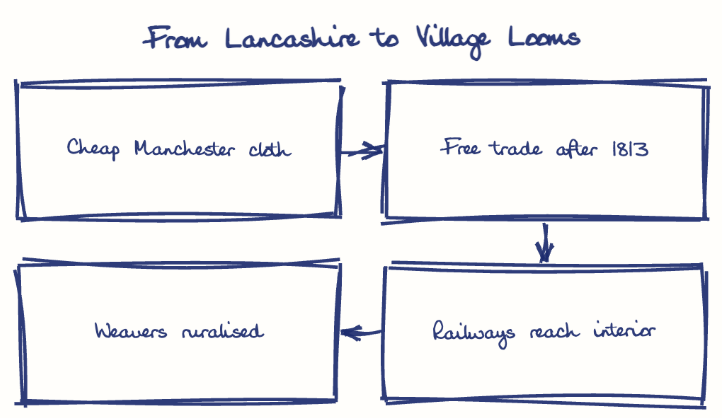
Lancashire's mechanised mills undersold Indian handloom cloth even in Indian bazaars.
Markets lost both ways
Cotton piece-goods fell from about 33% of India's exports in 1811-12 to about 3% by 1850-51, and by the 1870s made up over half of its imports.
Human cost
Dhaka shrank from about 1.5 lakh people to 30,000 to 40,000 by 1840, as Charles Trevelyan told Parliament, and Amiya Bagchi found Gangetic Bihar's industrial population fell from 18.6% to 8.5% by 1901.
One-way free trade
The Charter Act of 1813 opened India to British goods at nominal duties while Indian textiles faced heavy tariffs in Britain.
Lost patronage
The decline of Mughal and princely courts destroyed demand for luxury crafts, a collapse that owed nothing to steam.
Uneven decline
Railways after 1853 carried imports inland, yet coarse handloom weaving survived on mill yarn, as Tirthankar Roy shows.
Trade sovereignty
Unequal tariffs, not technology alone, decide who industrialises.
Craft with technology
As Swadeshi revived handlooms, design, credit and GI tags like Banarasi sarees can keep crafts competitive.
This model answer is indicative and the model can make mistakes; please verify key facts independently.
Practise this question
1Get the answer sheet
Sized for this question.
2Write your answer
Timed, by hand.
3Get it marked
Your score and what to fix.
This chapter in the exam
Industrial Revolution3 questions
Asked in 3 of 14 sittings since 2013
- 2015Why did the industrial revolution first occur in England? Discuss the quality of life of the people there during the industrialization. How does it compare with that in India at present?
- 2013‘Latecomer’ Industrial Revolution in Japan in involved certain factors that were markedly different from what West had experienced. Analyze.
Question from the official UPSC Civil Services (Main) Examination 2024 paper. Answer written by Ghissu's engine and checked against our editorial standards. Found an error? Tell us and we correct it within 48 hours.