2015 · GS Paper 2 · Q7 · 12 marks
Does the right to clean environment entail legal regulations on burning crackers during Diwali? Discuss in the light of Article 21 of the Indian Constitution and Judgements of the Apex Court in this regard.
In short
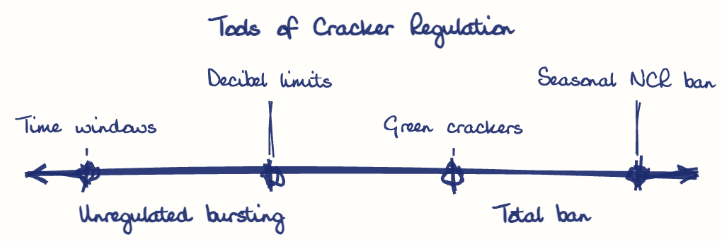
The right to a clean environment under Article 21 does entail legal regulation of crackers, but through proportionate curbs on timing, noise and chemistry rather than a blanket ban. In Arjun Gopal the Supreme Court allowed only green crackers for two hours on Diwali in 2018.
Model answer
Ghissu Editorial · Verified 4 Oct 2026 · 269 words
Noise curfew
In re Noise Pollution (2005) barred bursting crackers between 10 pm and 6 am, holding that festivity gives no right to impose noise on others.
Children's petition
In Arjun Gopal, filed in 2015 for three infants, the Court suspended Delhi-NCR sales in 2017 and in 2018 allowed only green crackers for two hours on Diwali.
Toxic chemistry
In 2021 it clarified there is no total ban, but crackers with barium salts stay prohibited.
Livelihoods
Sivakasi in Tamil Nadu makes most of India's fireworks, so green formulations from CSIR-NEERI protect workers' Article 19(1)(g) rights better than a ban.
Religious sentiment
The Court found curbs on timing and composition reasonable under Article 25, observing in 2024 that no religion encourages pollution.
Partial contribution
Crackers are a short-lived source beside stubble and vehicles, and enforcement by police and pollution boards stays weak.
This model answer is indicative and the model can make mistakes; please verify key facts independently.
Practise this question
1Get the answer sheet
Sized for this question.
2Write your answer
Timed, by hand.
3Get it marked
Your score and what to fix.
This chapter in the exam
Significant Provisions — Fundamental Rights9 questions
Asked in 8 of 14 sittings since 2013
- 2026Right to privacy relating to self-identity is very dear to every human being and well protected under Article 21 of the Constitution. In this context, examine the effect of the amendment in 2026, to the Transgender Persons (Protection of Rights) Act, 2019.
- 2024Right to privacy is intrinsic to life and personal liberty and is inherently protected under Article 21 of the constitution. Explain. In this reference discuss the law relating to D.N.A. testing of child in the womb to establish paternity.
All 9 questions, sorted by sub-topic, with model answers and practice.
Question from the official UPSC Civil Services (Main) Examination 2015 paper. Answer written by Ghissu's engine and checked against our editorial standards. Found an error? Tell us and we correct it within 48 hours.