2015 · GS Paper 2 · Q3 · 12 marks
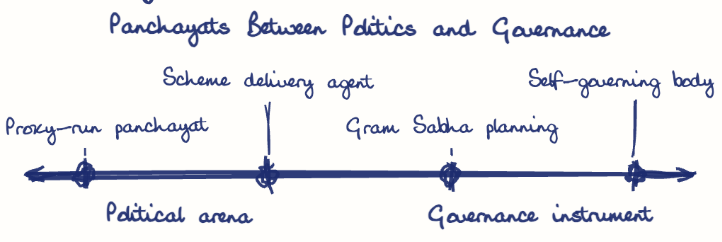
In absence of a well-educated and organized local level government system, Panchayats and Samitis have remained mainly political institutions and not effective instruments of governance. Critically discuss.
In short
Panchayats and Samitis often act as political arenas because of capacity deficits, patronage and proxy rule, but the deeper cause is weak devolution rather than low education. Kerala's People's Plan Campaign of 1996 shows that funded, trained panchayats work as real instruments of governance.
Model answer
Ghissu Editorial · Verified 4 Oct 2026 · 281 words
Capacity deficit
Many sarpanches cannot read budgets, and one secretary often serves several panchayats, so decisions drift to block officials and local brokers.
Patronage
Indirectly elected chairpersons of Samitis and Zila Parishads mirror party and caste bargaining, and beneficiary lists reward loyalty.
Proxy rule
"Sarpanch-pati" rule prompted the Ministry of Panchayati Raj to set up the Sushil Kumar Committee (2023).
Thin powers
Own sources give Panchayats only about 1% of revenue (RBI, 2024), and devolution reached just 43.9% on the Panchayat Devolution Index in 2021-22.
Need-based planning
Kerala's People's Plan Campaign (1996) and Gram Panchayat Development Plans show panchayats plan well when given funds and technical support.
Women's leadership
Chattopadhyay and Duflo (2004) found women-led panchayats invested more in drinking water.
Accountability tools
MGNREGA social audits and e-GramSwaraj accounting make panchayats answerable.
Learning, not exclusion
RGSA trained about 23.14 lakh women representatives in 2022-25, a better route than education bars that exclude Dalit and women aspirants.
This model answer is indicative and the model can make mistakes; please verify key facts independently.
Practise this question
1Get the answer sheet
Sized for this question.
2Write your answer
Timed, by hand.
3Get it marked
Your score and what to fix.
This chapter in the exam
Devolution — Panchayati Raj6 questions
Asked in 6 of 14 sittings since 2013
- 2022To what extent, in your opinion, has the decentralisation of power in India changed the governance landscape at the grassroots?
- 2020The strength sustenance of local institutions in India has shifted from their formative phase of Functions, Functionaries and Funds to the contemporary stage of Functionality. Highlight the critical challenges faced by local institutions in terms of their functionality in recent times.
All 6 questions, sorted by sub-topic, with model answers and practice.
Question from the official UPSC Civil Services (Main) Examination 2015 paper. Answer written by Ghissu's engine and checked against our editorial standards. Found an error? Tell us and we correct it within 48 hours.