2015 · GS Paper 2 · Q14 · 12 marks
In the light of the Satyam Scandal (2009), discuss the changes brought in corporate governance to ensure transparency, accountability.
In short
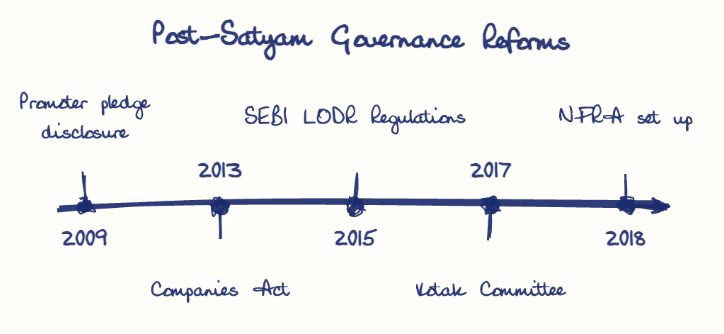
The Satyam scandal turned Indian corporate governance from voluntary practice into enforceable law built on independent boards, rotating auditors, mandatory disclosure and stronger enforcement. The Companies Act, 2013 mandated one-third independent directors and audit-firm rotation, and the National Financial Reporting Authority began regulating auditors in 2018.
Model answer
Ghissu Editorial · Verified 4 Oct 2026 · 281 words
Captive board
Independent directors approved the December 2008 bid for the Raju family's Maytas companies.
Audit failure
The auditor certified fictitious bank balances for years without direct bank confirmation.
Hidden pledges
Investors were never told that the promoters' shrinking stake was largely pledged.
Independent boards
The Companies Act, 2013 mandates one-third independent directors on listed boards with a Schedule IV code, a woman director, and an independent-majority audit committee.
Auditor accountability
Audit firms rotate after two five-year terms, cannot sell non-audit services to clients, and must report fraud, under the oversight of the National Financial Reporting Authority (2018).
Disclosure
SEBI mandated disclosure of pledged promoter shares in 2009 and consolidated listing duties in the LODR Regulations, 2015, and the Kotak Committee (2017) tightened board and related-party rules.
Enforcement
The SFIO gained statutory powers of arrest, vigil mechanisms became mandatory, and shareholders gained class-action suits.
This model answer is indicative and the model can make mistakes; please verify key facts independently.
Practise this question
1Get the answer sheet
Sized for this question.
2Write your answer
Timed, by hand.
3Get it marked
Your score and what to fix.
This chapter in the exam
Transparency & Accountability, Institutional and Other Measures4 questions
Asked in 4 of 14 sittings since 2013
- 2026“Transparency and accountability in governance are not about controlling corruption but about creating the trust of stakeholders in the policy process by following the Rule of Law and Participatory Governance.” Comment.
- 2020Recent amendments to the Right to information Act will have profound impact on the autonomy and independence of the Information Commission. Discuss.
All 4 questions, sorted by sub-topic, with model answers and practice.
Question from the official UPSC Civil Services (Main) Examination 2015 paper. Answer written by Ghissu's engine and checked against our editorial standards. Found an error? Tell us and we correct it within 48 hours.