2020 · GS Paper 2 · Q2 · 10 marks
Recent amendments to the Right to information Act will have profound impact on the autonomy and independence of the Information Commission. Discuss.
In short
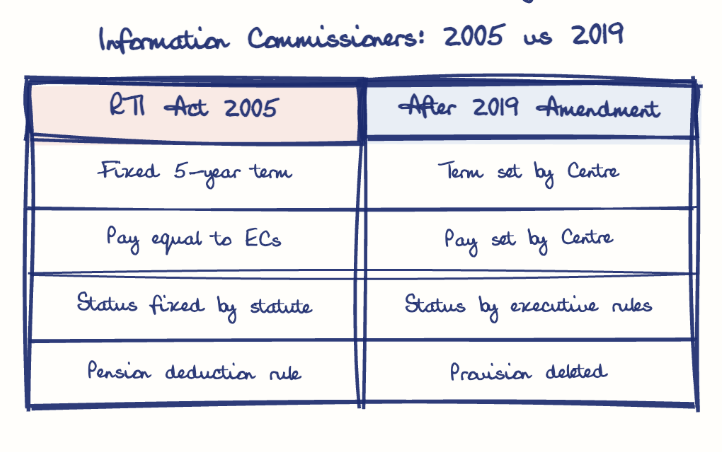
The 2019 amendment left Information Commissions' powers intact but let the Centre fix commissioners' tenure and salary, weakening the security that underpins their independence. The RTI Rules, 2019 cut the fixed five-year term to three years and ended parity with the Election Commission.
Model answer
Ghissu Editorial · Verified 4 Oct 2026 · 301 words
Executive control
Amended Sections 13 and 16 let the Centre prescribe term and salary for central and state commissioners, and the RTI Rules, 2019 cut the term to three years.
Government's rationale
The Centre called parity between a statutory body and the constitutional Election Commission an anomaly.
Powers untouched
The selection committee, removal only after a Supreme Court inquiry, and penalty powers remain intact.
Insecure tenure
Terms and salaries alterable by rules, which the 2019 Rules even let the Centre relax for any class of persons, create an incentive to please the government whose files a commissioner hears.
Lower status
Delinking from Election Commission parity weakens commissioners' standing before senior officials.
Federal concern
States appoint their commissioners, yet the Centre now fixes their service conditions.
Vacancies
Six of 29 commissions were defunct for periods in 2024-25, with over 4.1 lakh appeals pending (Satark Nagrik Sangathan, 2025), despite the Supreme Court's call for timely appointments in Anjali Bhardwaj (2019).
This model answer is indicative and the model can make mistakes; please verify key facts independently.
Practise this question
1Get the answer sheet
Sized for this question.
2Write your answer
Timed, by hand.
3Get it marked
Your score and what to fix.
This chapter in the exam
Transparency & Accountability, Institutional and Other Measures4 questions
Asked in 4 of 14 sittings since 2013
- 2026“Transparency and accountability in governance are not about controlling corruption but about creating the trust of stakeholders in the policy process by following the Rule of Law and Participatory Governance.” Comment.
- 2016In the integrity index of Transparency International, India stands very low. Discuss briefly the legal, political, social and cultural factors that have caused the decline of public morality in India.
All 4 questions, sorted by sub-topic, with model answers and practice.
Question from the official UPSC Civil Services (Main) Examination 2020 paper. Answer written by Ghissu's engine and checked against our editorial standards. Found an error? Tell us and we correct it within 48 hours.