2015 · GS Paper 2 · Q12 · 12 marks
Public health system has limitations in providing universal health coverage. Do you think that the private sector could help in bridging the gap? What other viable alternatives would you suggest?
In short
The private sector can help bridge India's universal health coverage gap only as a regulated partner bought through public purchasing, alongside higher public spending and primary care. PM-JAY buys private hospital care, while NHP 2017 targets public spending of 2.5% of GDP.
Model answer
Ghissu Editorial · Verified 4 Oct 2026 · 285 words
Strategic Purchasing
PM-JAY (2018) buys private hospital care for poor families, building on Gujarat's Chiranjeevi Yojana (2005), which paid private obstetricians for deliveries of poor women.
PPP in Service Gaps
The 108 ambulance network and the National Dialysis Programme (2016) run in PPP mode.
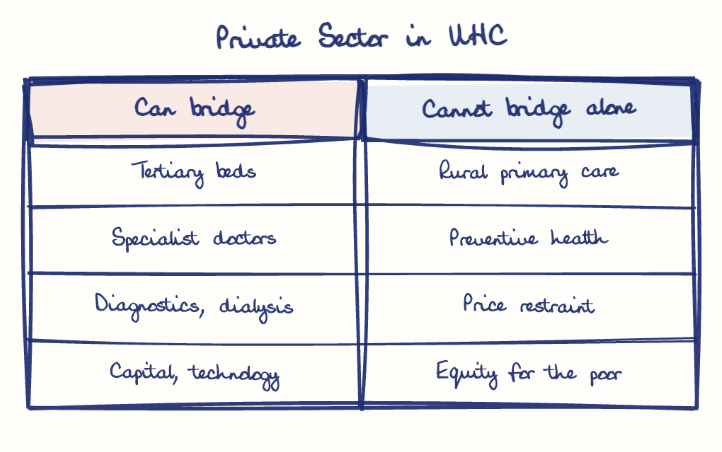
Limits of Market Provision
Private care clusters in cities and profitable curative services, and weak adoption of the Clinical Establishments Act, 2010 left overbilling unchecked, as COVID-19 treatment bills showed.
Raise Public Spending
The Srinath Reddy HLEG (2011) and National Health Policy 2017 seek 2.5% of GDP.
Strengthen Primary Care
Ayushman Arogya Mandirs with Community Health Officers prevent costly hospitalisation.
Free Medicines
Tamil Nadu Medical Services Corporation's pooled procurement cuts the largest out-of-pocket cost.
Pooling and Telemedicine
Extending ESIC to informal workers and scaling eSanjeevani widen reach.
This model answer is indicative and the model can make mistakes; please verify key facts independently.
Practise this question
1Get the answer sheet
Sized for this question.
2Write your answer
Timed, by hand.
3Get it marked
Your score and what to fix.
This chapter in the exam
Health6 questions
Asked in 5 of 14 sittings since 2013
- 2024In a crucial domain like the public healthcare system the Indian State should play a vital role to contain the adverse impact of marketisation of the system. Suggest some measures through which the State can enhance the reach of public healthcare at the grassroots level.
- 2021"Besides being a moral imperative of a Welfare State, primary health structure is a necessary precondition for sustainable development." Analyze.
All 6 questions, sorted by sub-topic, with model answers and practice.
Question from the official UPSC Civil Services (Main) Examination 2015 paper. Answer written by Ghissu's engine and checked against our editorial standards. Found an error? Tell us and we correct it within 48 hours.