2015 · GS Paper 2 · Q5 · 12 marks
Resorting to ordinances has always raised concern on violation of the spirit of separation of powers doctrine. While noting the rationales justifying the power to promulgate ordinances, analyze whether the decisions of the Supreme Court on the issue have further facilitated resorting to this power. Should the power to promulgate ordinances be repealed?
In short
Supreme Court rulings first facilitated ordinances by treating the power as legislative, but later rulings curbed re-promulgation, so the power should be retained with safeguards rather than repealed. Krishna Kumar Singh (2017) made the President's satisfaction justiciable and laying before the legislature mandatory.
Model answer
Ghissu Editorial · Verified 4 Oct 2026 · 289 words
Urgency between sessions
The Epidemic Diseases (Amendment) Ordinance 2020 protected health workers when Parliament could not meet.
Economic emergencies
The Taxation Laws (Amendment) Ordinance 2019 cut corporate tax at once to revive investment.
Safeguards
Ordinances lapse six weeks after reassembly, and the 44th Amendment (1978) removed the bar on reviewing the President's satisfaction.
Facilitating
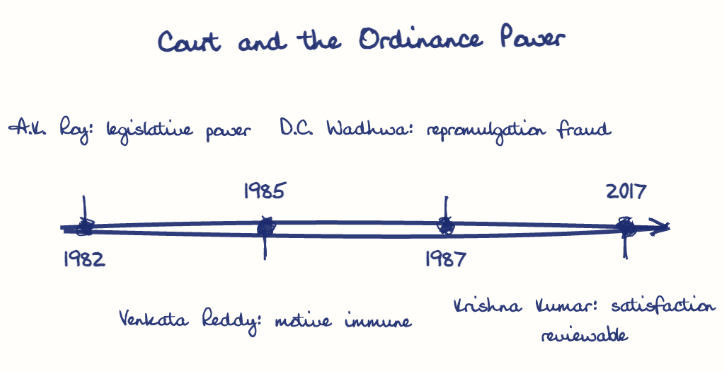
A.K. Roy (1982) treated the power as legislative, and T. Venkata Reddy (1985) shielded ordinances from challenge on motive or necessity.
Restraining
D.C. Wadhwa (1987) called Bihar's 256 re-promulgated ordinances a fraud on the Constitution, and Krishna Kumar Singh (2017) made satisfaction justiciable and laying mandatory.
Weak deterrence
The Muslim Women ordinance was still issued in 2018 and re-promulgated twice in 2019, because the Court rarely tests urgency in practice.
Retain for emergencies
Repeal would leave governments helpless in a crisis between sessions, as in 2020.
Reform instead
Limits on re-promulgation and prompt laying before the legislature would curb misuse.
This model answer is indicative and the model can make mistakes; please verify key facts independently.
Practise this question
1Get the answer sheet
Sized for this question.
2Write your answer
Timed, by hand.
3Get it marked
Your score and what to fix.
This chapter in the exam
Separation of Powers between Various Organs4 questions
Asked in 4 of 14 sittings since 2013
- 2020Judicial Legislation is antithetical to the doctrine of separation of powers as envisaged in the Indian Constitution. In this context justify the filing of large number of public interest petitions praying for issuing guidelines to executive authorities.
- 2019Do you think that constitution of India does not accept principle of strict separation of powers rather it is based on the principle of checks and balance? Explain.
All 4 questions, sorted by sub-topic, with model answers and practice.
Question from the official UPSC Civil Services (Main) Examination 2015 paper. Answer written by Ghissu's engine and checked against our editorial standards. Found an error? Tell us and we correct it within 48 hours.