2015 · GS Paper 2 · Q2 · 12 marks
The concept of cooperative federalism has been increasingly emphasised in recent years. Highlight the drawbacks in the existing structure and extent to which cooperative federalism would answer the shortcomings.
In short
Cooperative federalism largely answers India's fiscal and planning drawbacks but only partially the political ones rooted in Article 356, the Governor's office and idle forums. NITI Aayog's Governing Council (2015) and the 14th Finance Commission's rise in tax devolution from 32% to 42% embody it.
Model answer
Ghissu Editorial · Verified 4 Oct 2026 · 297 words
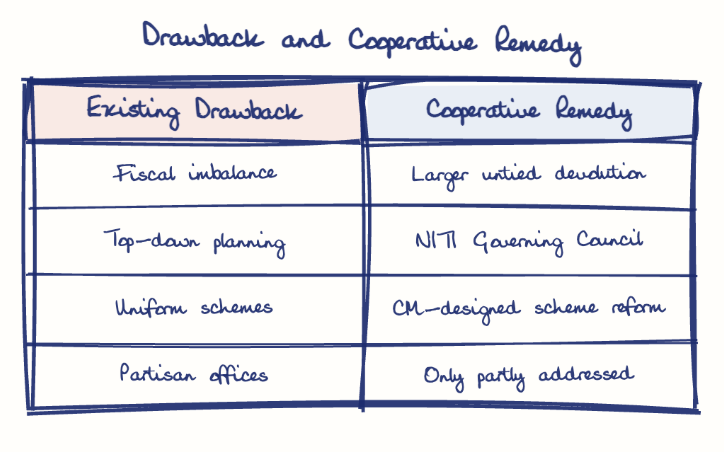
Fiscal imbalance
States carry most social spending, but the Centre holds the buoyant taxes, and cesses stay outside the divisible pool under Article 270.
Top-down planning
Discretionary Planning Commission grants and uniform Centrally Sponsored Schemes, faulted by the B.K. Chaturvedi Committee (2011), made states mere implementers.
Partisan offices and idle forums
Article 356 was used over 100 times before S.R. Bommai (1994), and the Inter-State Council under Article 263 did not meet between 2006 and 2016.
Fiscal gap narrows
Untied devolution and the GST Council under Article 279A, with states holding two-thirds of the votes, pool sovereignty, though cesses claw back part of the gain.
Consultative planning
The Sub-Group of Chief Ministers (2015) regrouped the CSS into core and optional schemes, so states shape what they run.
Political limits
Goodwill cannot curb the Governor's discretion, as Nabam Rebia (2016) on Arunachal Pradesh showed, and Mohit Minerals (2022) called GST Council advice persuasive, not binding.
This model answer is indicative and the model can make mistakes; please verify key facts independently.
Practise this question
1Get the answer sheet
Sized for this question.
2Write your answer
Timed, by hand.
3Get it marked
Your score and what to fix.
This chapter in the exam
Issues & Challenges Pertaining to the Federal Structure5 questions
Asked in 4 of 14 sittings since 2013
- 2020Indian constitution exhibits centralising tendencies to maintain unity and integrity of the nation. Elucidate in the perspective of the Epidemic Diseases Act, 1897; The Disaster Management Act, 2005 and recently passed Farm Acts.
- 2020How far do you think cooperation, competition and confrontation have shaped the nature of federation in India? Cite some recent examples to validate your answer.
All 5 questions, sorted by sub-topic, with model answers and practice.
Question from the official UPSC Civil Services (Main) Examination 2015 paper. Answer written by Ghissu's engine and checked against our editorial standards. Found an error? Tell us and we correct it within 48 hours.