2015 · GS Paper 3 · Q8 · 12 marks
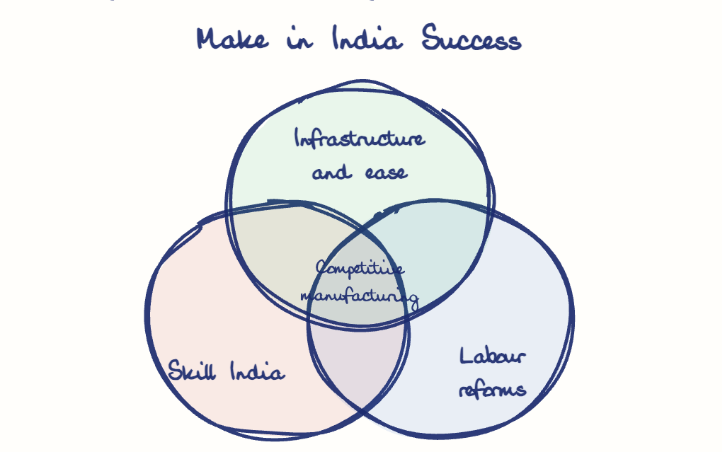
"Success of 'Make in India' programme depends on the success of 'Skill India' programme and radical labour reforms." Discuss with logical arguments.
In short
Make in India does depend on Skill India and labour reform, since manufacturing needs skilled workers and flexible hiring, but both are necessary rather than sufficient without infrastructure, capital and stable policy. Only 4.69% of India's workforce was formally skilled in 2015.
Model answer
Ghissu Editorial · Verified 4 Oct 2026 · 273 words
Productivity and quality
Global value chains need certified technicians, which is why MeitY's Chips to Startup programme aims to train 85,000 chip-design professionals.
Demographic dividend
Roughly 12 million youth enter the workforce each year, and without skills they remain in low-productivity informal work.
Hiring flexibility
Chapter V-B of the Industrial Disputes Act required permission for layoffs in units of 100 or more, which the Economic Survey 2018-19 tied to firm dwarfism.
Compliance burden
Forty-four central labour laws pushed firms towards contract labour rather than trained, formal staff.
Skills without demand
PMKVY has trained about 1.6 crore youth since 2015 (MSDE, 2026), but weak placement shows training yields jobs only where factories exist.
Ecosystem costs
Logistics at 7.8-8.9% of GDP (NCAER, 2021-22), costly land and inverted duties weigh as much as wages.
Security with flexibility
The four Labour Codes, operational from November 2025, pair easier hiring with social security for gig and contract workers.
This model answer is indicative and the model can make mistakes; please verify key facts independently.
Practise this question
1Get the answer sheet
Sized for this question.
2Write your answer
Timed, by hand.
3Get it marked
Your score and what to fix.
This chapter in the exam
Industrial Policy3 questions
Asked in 2 of 14 sittings since 2013
- 2025Discuss the rationale of the Production Linked Incentive (PLI) scheme. What are its achievements ? In what way can the functioning and outcomes of the scheme be improved ?
- 2015There is a clear acknowledgement that Special Economic Zones (SEZs) are a tool of industrial development, manufacturing and exports. Recognizing this potential, the whole instrumentality of SEZs requires augmentation. Discuss the issues plaguing the success of SEZs with respect to taxation, governing laws and administration.
Question from the official UPSC Civil Services (Main) Examination 2015 paper. Answer written by Ghissu's engine and checked against our editorial standards. Found an error? Tell us and we correct it within 48 hours.