2025 · GS Paper 3 · Q12 · 15 marks
Discuss the rationale of the Production Linked Incentive (PLI) scheme. What are its achievements ? In what way can the functioning and outcomes of the scheme be improved ?
In short
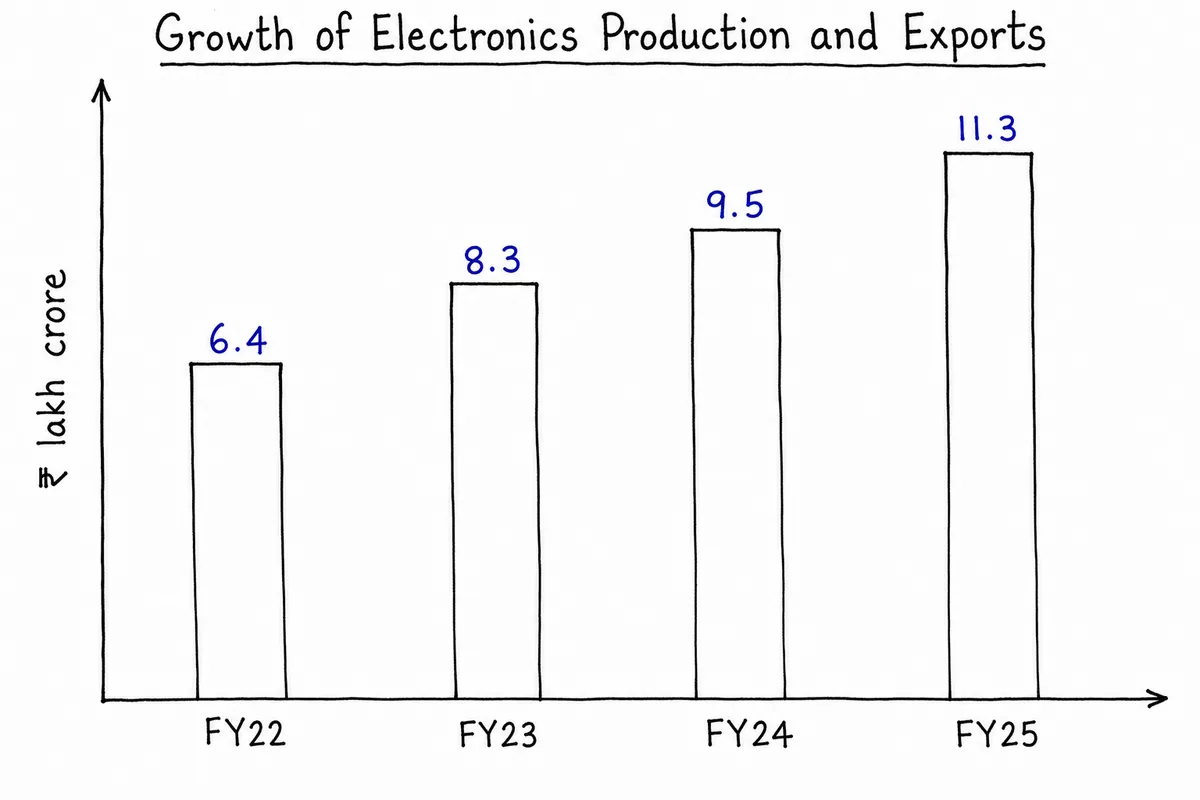
The PLI scheme pays output-linked incentives to offset India's manufacturing cost disability and strategic import dependence, and has scaled electronics, investment and exports, but needs deeper value addition, faster delivery and wider inclusion. Electronics production rose from Rs 6.4 lakh crore in FY22 to Rs 11.3 lakh crore in FY25.
Model answer
Ghissu Editorial · Verified 4 Oct 2026 · 282 words
Stalled manufacturing
Manufacturing has hovered around 15-17% of GDP for decades, too small to absorb workers leaving farms.
Cost disability
MeitY estimated an 8.5-11% cost disadvantage for electronics makers, which a 4-6% incentive was designed to offset.
Strategic dependence
COVID-19 shocks exposed reliance on China for APIs, electronics and solar modules.
Electronics surge
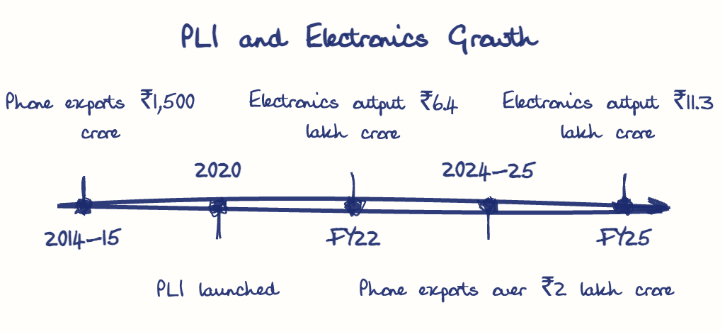
Production rose from ₹6.4 lakh crore in FY22 to ₹11.3 lakh crore in FY25 (Economic Survey 2025-26), making India the second-largest mobile maker.
Exports and investment
Mobile exports topped ₹2 lakh crore in 2024-25, and actual investment crossed ₹2 lakh crore by September 2025 (DPIIT).
Health security
21 medical device projects now make 54 devices earlier imported.
Deepen value addition
Since mobile PLI largely rewards assembly (Rajan and co-authors, 2023), the Electronics Component Manufacturing Scheme (2025) must build components.
Fix uneven delivery
Reallocate unspent outlays from lagging sectors such as textiles and ACC batteries, and settle claims on time.
Ecosystem and inclusion
Pair incentives with logistics under PM Gati Shakti, skills, MSME access and labour-intensive sectors such as footwear.
This model answer is indicative and the model can make mistakes; please verify key facts independently.
Practise this question
1Get the answer sheet
Sized for this question.
2Write your answer
Timed, by hand.
3Get it marked
Your score and what to fix.
This chapter in the exam
Industrial Policy3 questions
Asked in 2 of 14 sittings since 2013
- 2015There is a clear acknowledgement that Special Economic Zones (SEZs) are a tool of industrial development, manufacturing and exports. Recognizing this potential, the whole instrumentality of SEZs requires augmentation. Discuss the issues plaguing the success of SEZs with respect to taxation, governing laws and administration.
- 2015"Success of 'Make in India' programme depends on the success of 'Skill India' programme and radical labour reforms." Discuss with logical arguments.
Question from the official UPSC Civil Services (Main) Examination 2025 paper. Answer written by Ghissu's engine and checked against our editorial standards. Found an error? Tell us and we correct it within 48 hours.