2015 · GS Paper 3 · Q10 · 12 marks
There is a clear acknowledgement that Special Economic Zones (SEZs) are a tool of industrial development, manufacturing and exports. Recognizing this potential, the whole instrumentality of SEZs requires augmentation. Discuss the issues plaguing the success of SEZs with respect to taxation, governing laws and administration.
In short
SEZs are held back by eroded and uncertain tax incentives, laws that overlap with mainland and state rules, and a multi-layered approval system that is no true single window. MAT and DDT imposed in Budget 2011-12 removed much of the promised tax advantage.
Model answer
Ghissu Editorial · Verified 4 Oct 2026 · 280 words
MAT and DDT shock
Budget 2011-12 imposed Minimum Alternate Tax on SEZ units and developers and Dividend Distribution Tax on developers, eroding the promised tax holiday.
Policy flip-flops
The draft Direct Taxes Code proposed withdrawing SEZ exemptions, unsettling long-gestation investors.
WTO vulnerability
Export-linked Section 10AA exemptions are open to challenge as prohibited subsidies, as the United States did in 2018.
Land conflict
Nandigram (2007) and Goa's cancellation of its SEZs made them land-banking controversies.
Overlapping laws
Central labour, environment and state laws still apply, so the Act is no single code.
Domestic market barrier
Sales into the Domestic Tariff Area pay full customs duty, while FTA partners' goods often enter cheaper.
Layered clearances
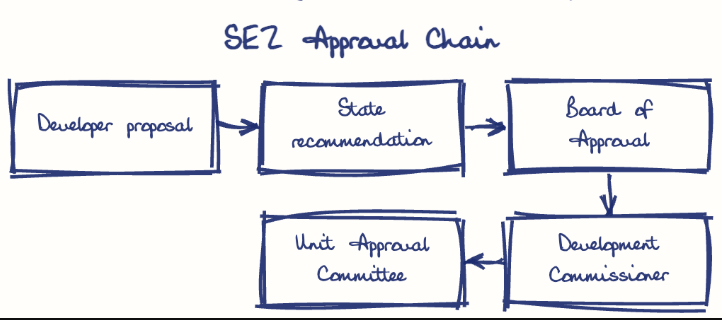
Approvals pass through the state, the Board of Approval and the Development Commissioner, while state permits stay outside the window.
Weak monitoring
The Development Commissioner is both promoter and regulator, and the CAG found investment and export commitments untracked.
This model answer is indicative and the model can make mistakes; please verify key facts independently.
Practise this question
1Get the answer sheet
Sized for this question.
2Write your answer
Timed, by hand.
3Get it marked
Your score and what to fix.
This chapter in the exam
Industrial Policy3 questions
Asked in 2 of 14 sittings since 2013
- 2025Discuss the rationale of the Production Linked Incentive (PLI) scheme. What are its achievements ? In what way can the functioning and outcomes of the scheme be improved ?
- 2015"Success of 'Make in India' programme depends on the success of 'Skill India' programme and radical labour reforms." Discuss with logical arguments.
Question from the official UPSC Civil Services (Main) Examination 2015 paper. Answer written by Ghissu's engine and checked against our editorial standards. Found an error? Tell us and we correct it within 48 hours.