2015 · GS Paper 4 · Q3(a) · 10 marks
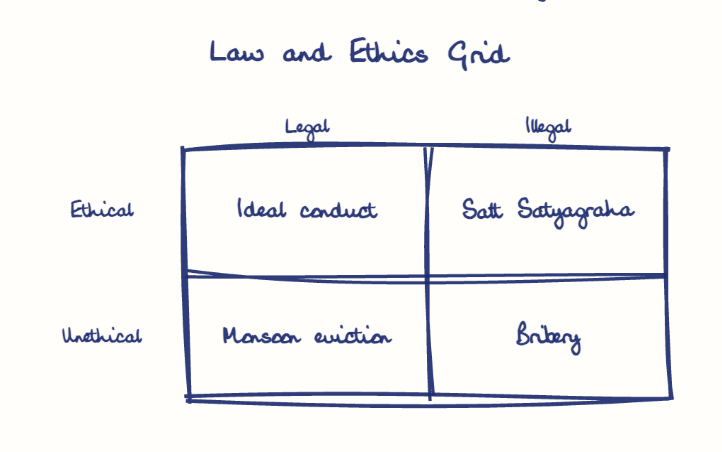
"A mere compliance with law is not enough, the public servant also has to have a well-developed sensibility to ethical issues for effective discharge of duties." Do you agree? Explain with the help of two examples, where (i) an act is ethically right, but not legally and (ii) an act is legally right, but not ethically.
In short
Mere legal compliance is necessary but not sufficient, because law is only a floor and ethical sensibility guides officers where rules are silent or unjust. The Salt Satyagraha was ethically right but illegal, while a monsoon slum demolition without rehabilitation is lawful but unethical.
Model answer
Ghissu Editorial · Verified 4 Oct 2026 · 273 words
Law is only a floor
"No rule was broken" is Ethical Minimalism, legality standing in for morality, and it leaves citizens failed by an officer who broke no rule.
Rules cannot foresee everything
Conscience guides discretion, as when Armstrong Pame built Manipur's "People's Road" in 2012 through public contributions.
Mechanical obedience can hurt
Refusing a dying patient for want of a document is Rule-Bound Amoralism, which Gandhi's Talisman corrects by asking how an act helps the weakest.
Ethically right, not legally
The Salt Satyagraha (1930) broke an unjust law; a Collector who opens a godown to feed flood-stranded families before sanction breaches rules yet acts rightly.
Legally right, not ethically
Demolishing a slum in peak monsoon under a valid order without rehabilitation is lawful but uncompassionate, though Olga Tellis (1985) linked livelihood to Article 21.
Unjust laws
Enforcing Section 377 IPC was lawful until Navtej Singh Johar (2018).
This model answer is indicative and the model can make mistakes; please verify key facts independently.
Practise this question
1Get the answer sheet
Sized for this question.
2Write your answer
Timed, by hand.
3Get it marked
Your score and what to fix.
This chapter in the exam
Laws, rules, regulations and conscience as sources of ethical guidance16 questions
Asked in 9 of 14 sittings since 2013
- 2026Dr. B. R. Ambedkar had cautioned that employing civil disobedience within a constitutional democracy equates to endorsing 'anarchy'. How should modern democracies navigate the ethical dilemmas posed by civil disobedience movements that aim to promote social justice against policies that may raise genuine concerns?
- 2026Usually schools, working in remote areas, do not fully comply with government regulations. However, if the rules are enforced strictly, it would lead to most schools closing down. How should an administrator strike a balance between enforcement of rules and educational rights of children?
All 16 questions, sorted by sub-topic, with model answers and practice.
Question from the official UPSC Civil Services (Main) Examination 2015 paper. Answer written by Ghissu's engine and checked against our editorial standards. Found an error? Tell us and we correct it within 48 hours.