2026 · GS Paper 4 · Q3(a) · 10 marks
Dr. B. R. Ambedkar had cautioned that employing civil disobedience within a constitutional democracy equates to endorsing 'anarchy'. How should modern democracies navigate the ethical dilemmas posed by civil disobedience movements that aim to promote social justice against policies that may raise genuine concerns?
In short
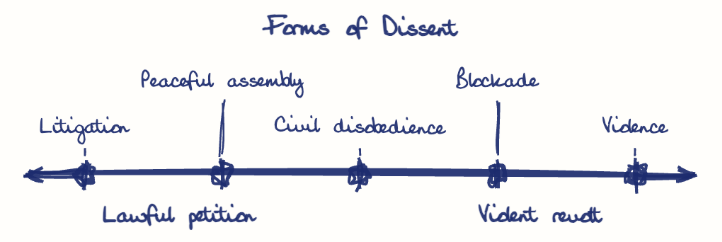
Modern democracies should treat Ambedkar's warning as a caution about methods, protecting peaceful dissent proportionately, engaging movements that are non-violent and conscientious, and keeping constitutional channels responsive. The Supreme Court in MKSS (2018) struck down a total ban on Jantar Mantar protests while Amit Sahni (2020) barred indefinite road occupation.
Model answer
Ghissu Editorial · Verified 4 Oct 2026 · 277 words
Ambedkar's caution
Courts under Article 32, elections and a free press exist, so bypassing them lets any group put its conscience above the common law.
Risk of violence
Gandhi himself withdrew the Non-Cooperation Movement after Chauri Chaura in 1922.
Claim of conscience
Martin Luther King Jr. argued in his Letter from Birmingham Jail (1963) that there is a moral responsibility to disobey unjust laws.
Conditional warning
Ambedkar led the Mahad Satyagraha in 1927 under colonial rule, before any constitutional democracy existed, so his caution applies where fair channels exist.
Protect peaceful dissent
MKSS v Union of India (2018) struck down a total ban on Jantar Mantar protests, while Amit Sahni (2020) barred indefinite occupation of roads, a proportionality balance.
Test of legitimacy
John Rawls (1971) treats civil disobedience as public, non-violent and conscientious; such movements deserve engagement.
Listen before law
The repeal of the three farm laws in 2021 after a year-long protest showed the cost of skipping pre-legislative consultation.
Restraint in policing
Kedar Nath Singh (1962) confined sedition to incitement to violence.
This model answer is indicative and the model can make mistakes; please verify key facts independently.
Practise this question
1Get the answer sheet
Sized for this question.
2Write your answer
Timed, by hand.
3Get it marked
Your score and what to fix.
This chapter in the exam
Laws, rules, regulations and conscience as sources of ethical guidance16 questions
Asked in 9 of 14 sittings since 2013
- 2026Usually schools, working in remote areas, do not fully comply with government regulations. However, if the rules are enforced strictly, it would lead to most schools closing down. How should an administrator strike a balance between enforcement of rules and educational rights of children?
- 2026On the request of his Personal Assistant (PA), the District Magistrate (DM) stops the transfer of a schoolteacher who takes private tuition for his daughter diagnosed with learning disability. In this context, discuss the aspects of empathy versus compliance with rules.
All 16 questions, sorted by sub-topic, with model answers and practice.
Question from the official UPSC Civil Services (Main) Examination 2026 paper. Answer written by Ghissu's engine and checked against our editorial standards. Found an error? Tell us and we correct it within 48 hours.