2026 · GS Paper 4 · Q5(a) · 10 marks
Usually schools, working in remote areas, do not fully comply with government regulations. However, if the rules are enforced strictly, it would lead to most schools closing down. How should an administrator strike a balance between enforcement of rules and educational rights of children?
In short
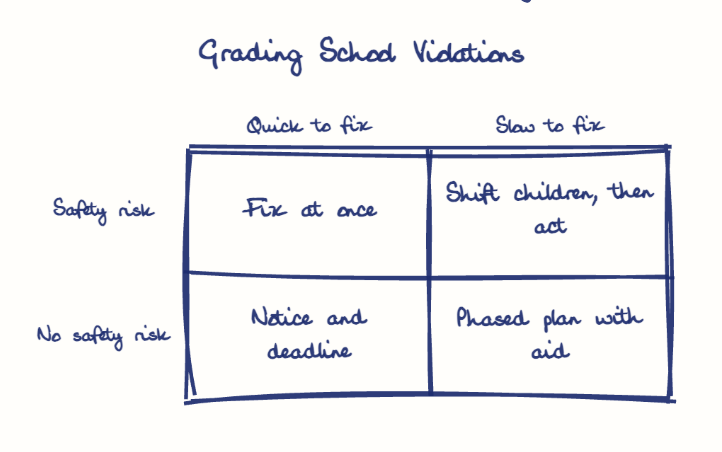
An administrator should grade enforcement, holding safety norms firm, giving time-bound plans and support for other gaps, and never closing a school before every child is placed elsewhere. After the 2004 Kumbakonam fire, Avinash Mehrotra (2009) made school safety part of the right to education.
Model answer
Ghissu Editorial · Verified 4 Oct 2026 · 284 words
Safety is non-negotiable
After the Kumbakonam school fire of 2004 killed 94 children, Avinash Mehrotra v Union of India (2009) made school safety part of the right to education.
Time to comply
Section 19 of the RTE Act, 2009 gave schools three years to meet its norms; written, time-bound plans can cover gaps like playgrounds.
Support before penalty
Samagra Shiksha grants and CSR can build classrooms and toilets, making the inspector a facilitator.
Outcomes over inputs
NEP 2020 asks regulation to move from input norms towards learning outcomes and public disclosure.
No child out of school
Where closure is unavoidable, every child is first placed in a neighbourhood school under Section 6, with transport for long distances.
Community oversight
School Management Committees under Section 21 let parents track progress.
Equity lens
Gandhi's talisman directs attention to the tribal, first-generation learner who has no other school, guarding against rule-bound amoralism, where the rule is obeyed and its purpose forgotten.
This model answer is indicative and the model can make mistakes; please verify key facts independently.
Practise this question
1Get the answer sheet
Sized for this question.
2Write your answer
Timed, by hand.
3Get it marked
Your score and what to fix.
This chapter in the exam
Laws, rules, regulations and conscience as sources of ethical guidance16 questions
Asked in 9 of 14 sittings since 2013
- 2026Dr. B. R. Ambedkar had cautioned that employing civil disobedience within a constitutional democracy equates to endorsing 'anarchy'. How should modern democracies navigate the ethical dilemmas posed by civil disobedience movements that aim to promote social justice against policies that may raise genuine concerns?
- 2026On the request of his Personal Assistant (PA), the District Magistrate (DM) stops the transfer of a schoolteacher who takes private tuition for his daughter diagnosed with learning disability. In this context, discuss the aspects of empathy versus compliance with rules.
All 16 questions, sorted by sub-topic, with model answers and practice.
Question from the official UPSC Civil Services (Main) Examination 2026 paper. Answer written by Ghissu's engine and checked against our editorial standards. Found an error? Tell us and we correct it within 48 hours.