2015 · GS Paper 4 · Q1(b)(iii) · 2 marks
Differentiate between the following: Discrimination and Preferential treatment
In short
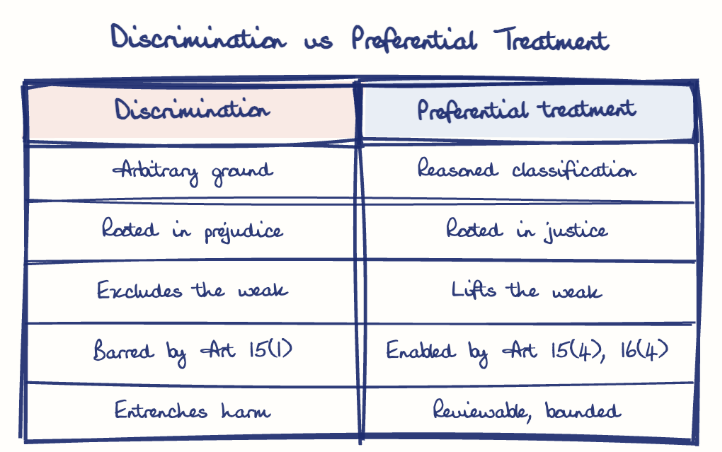
Discrimination is unfavourable treatment on an irrelevant ground such as caste or religion, while preferential treatment is a reasoned advantage that helps the disadvantaged reach substantive equality. Indra Sawhney (1992) upheld reservation but capped it at 50% and excluded the creamy layer.
Model answer
Ghissu Editorial · Verified 4 Oct 2026 · 299 words
Discrimination
Unfavourable treatment on an irrelevant ground such as caste, religion or sex, barred to the State by Article 15(1) and, as untouchability, by Article 17; a landlord refusing to rent to a Dalit family is a social example.
Preferential treatment
A deliberate advantage to a disadvantaged group to correct historical disadvantage, as in reservation upheld in Indra Sawhney (1992) and the EWS quota upheld in Janhit Abhiyan (2022).
Basis
Discrimination fails Article 14's reasonable-classification test; preferential treatment passes it, since N.M. Thomas (1976) read reservation as a facet of equality.
Moral standing
Rawls's Difference Principle permits inequality only if it helps the least advantaged, which preferential treatment does and discrimination inverts.
Limits
Preference turns discriminatory when excessive or captured, hence Indra Sawhney's 50% ceiling and creamy-layer exclusion.
Favouritism
An officer's preference for kin or caste is not affirmative action but Impartiality Erosion, resting on proximity rather than a public rule.
This model answer is indicative and the model can make mistakes; please verify key facts independently.
Practise this question
1Get the answer sheet
Sized for this question.
2Write your answer
Timed, by hand.
3Get it marked
Your score and what to fix.
This chapter in the exam
Impartiality and non-partisanship3 questions
Asked in 3 of 14 sittings since 2013
- 2021Should impartial and being non-partisan be considered as indispensable qualities to make a successful civil servant? Discuss with illustrations.
- 2016Why should impartiality and non-partisanship be considered as foundational values in public services, especially in the present day socio-political context ? Illustrate your answer with examples.
Question from the official UPSC Civil Services (Main) Examination 2015 paper. Answer written by Ghissu's engine and checked against our editorial standards. Found an error? Tell us and we correct it within 48 hours.