2021 · GS Paper 4 · Q5(b) · 10 marks
Should impartial and being non-partisan be considered as indispensable qualities to make a successful civil servant? Discuss with illustrations.
In short
Impartiality and non-partisanship are indispensable for a successful civil servant because they secure equal citizenship and frank advice to every government, but they must be joined with constitutional commitment and empathy. The Shah Commission (1978) showed how officials who obeyed illegal Emergency orders became instruments of excess.
Model answer
Ghissu Editorial · Verified 4 Oct 2026 · 284 words
Equal citizenship
Articles 14 and 16 promise equal treatment, which only an impartial officer delivers in a police station or a tender committee.
Frank advice
Sardar Patel told the Constituent Assembly in 1949 that an All-India Service needs the independence to speak out its mind, possible only for an officer tied to no party.
Cost of their absence
The Shah Commission (1978) found many officials carried out illegal orders during the Emergency, showing how partisanship breeds excess.
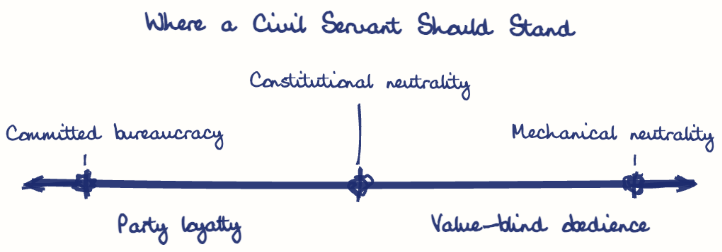
Neutrality is not value-blindness
Eichmann's plea that he merely followed orders, Hannah Arendt's "banality of evil", shows obedience without conscience serving grave wrongs.
Commitment to the Constitution
The 1970s "committed bureaucracy" was rightly resisted as party loyalty, yet officers must stay committed to justice and dignity.
Empathy for the weakest
S.R. Sankaran enforced the Bonded Labour System (Abolition) Act, 1976 and built schools for Dalits, showing that fairness sometimes demands active care.
This model answer is indicative and the model can make mistakes; please verify key facts independently.
Practise this question
1Get the answer sheet
Sized for this question.
2Write your answer
Timed, by hand.
3Get it marked
Your score and what to fix.
This chapter in the exam
Impartiality and non-partisanship3 questions
Asked in 3 of 14 sittings since 2013
Question from the official UPSC Civil Services (Main) Examination 2021 paper. Answer written by Ghissu's engine and checked against our editorial standards. Found an error? Tell us and we correct it within 48 hours.