2016 · GS Paper 4 · Q1(b) · 10 marks
Why should impartiality and non-partisanship be considered as foundational values in public services, especially in the present day socio-political context ? Illustrate your answer with examples.
In short
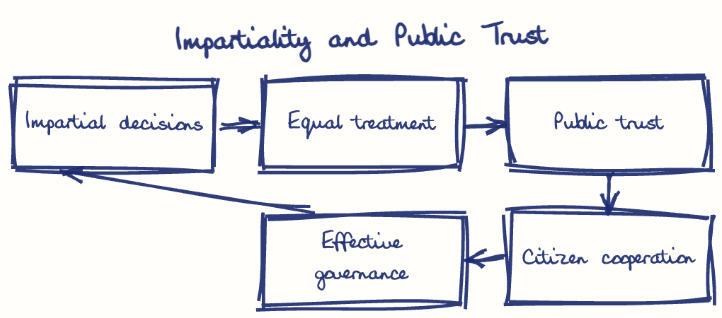
Impartiality and non-partisanship are foundational because they turn the constitutional promise of equality into fair service and let a permanent bureaucracy serve every elected government, which matters more amid today's polarisation. T.N. Seshan's even-handed enforcement of the Model Code of Conduct restored public faith in elections.
Model answer
Ghissu Editorial · Verified 4 Oct 2026 · 266 words
Constitutional promise
Articles 14, 15 and 16 guarantee equal treatment, which only an impartial officer turns into equal access to services and justice.
Continuity and legitimacy
A permanent service must implement any elected government's policies, and T.N. Seshan's even-handed enforcement of the Model Code of Conduct (1990-96) showed how neutrality restores public faith.
Not indifference
Uniformly applying reservations under Articles 15(4) and 16(4) is itself impartial, because impartiality means equal application of the law, not blindness to disadvantage.
Polarised society
Caste and religious tensions test officers during riots and protests, and the Supreme Court in Prakash Singh (2006) ordered police reforms against political interference.
Politicised transfers
Ashok Khemka's more than 50 transfers, including after cancelling a controversial land mutation in 2012, show the pressure on neutral officers.
Codified neutrality
As pressure on officers grows, the 2014 amendment to the All India Services (Conduct) Rules, 1968 made political neutrality an explicit duty.
Technology as an ally
Aadhaar-linked Direct Benefit Transfer removes discretionary middlemen, building impartiality into delivery.
This model answer is indicative and the model can make mistakes; please verify key facts independently.
Practise this question
1Get the answer sheet
Sized for this question.
2Write your answer
Timed, by hand.
3Get it marked
Your score and what to fix.
This chapter in the exam
Impartiality and non-partisanship3 questions
Asked in 3 of 14 sittings since 2013
Question from the official UPSC Civil Services (Main) Examination 2016 paper. Answer written by Ghissu's engine and checked against our editorial standards. Found an error? Tell us and we correct it within 48 hours.