2015 · GS Paper 4 · Q1(b)(iv) · 2 marks
Differentiate between the following: Personal ethics and Professional ethics
In short
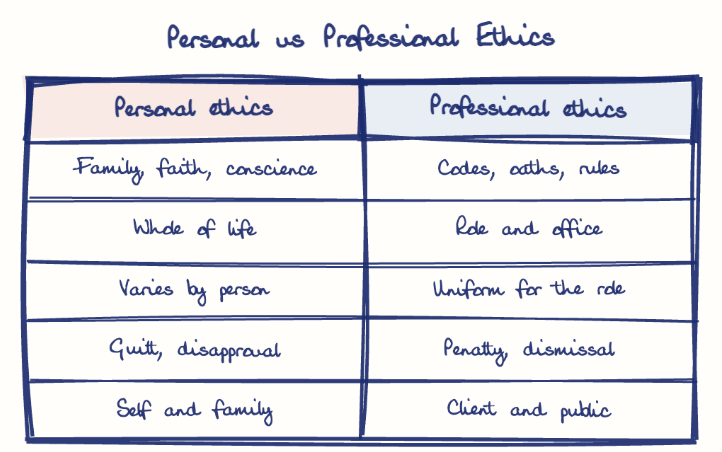
Personal ethics are an individual's own principles drawn from family, faith and conscience, while professional ethics are codified, uniform standards of a role enforced by formal penalties. They reinforce each other, as T.N. Seshan's personal courage gave force to the Model Code of Conduct.
Model answer
Ghissu Editorial · Verified 4 Oct 2026 · 304 words
Source
Personal ethics come from socialisation, as Gandhi took his resolve to follow truth from the Harishchandra play; professional ethics are codified, as in the All India Services (Conduct) Rules 1968.
Scope and uniformity
Personal ethics vary by person across all of life; professional ethics bind every holder alike, so a vegetarian food-safety officer must still inspect a meat unit impartially.
Enforcement and beneficiary
A personal lapse brings guilt, a professional breach brings penalties up to dismissal, subject to Article 311 safeguards, since professional ethics protect a dependent citizen or client.
Foundation
Professional codes rest on personal integrity; T.N. Seshan's enforcement of the Model Code of Conduct drew on personal courage no rulebook supplies.
Conflict
When they clash, the role prevails within law, as an officer recusing from a relative's file avoids Conflict of Interest Blindness, the failure to see divided loyalties.
Danger of separation
Moral Fragmentation, honesty at home but indifference at work, is what the Nolan Principles (1995) counter by demanding integrity through personal example.
This model answer is indicative and the model can make mistakes; please verify key facts independently.
Practise this question
1Get the answer sheet
Sized for this question.
2Write your answer
Timed, by hand.
3Get it marked
Your score and what to fix.
This chapter in the exam
Ethics in private and public relationships3 questions
Asked in 3 of 14 sittings since 2013
- 2014The current society is plagued with widespread trust-deficit. What are the consequences of this situation for personal well-being and for societal well-being? What can you do at the personal level to make yourself trustworthy?
- 2013"The good of an individual is contained in the good of all." What do you understand by this statement? How can this principle be implemented in public life?
Question from the official UPSC Civil Services (Main) Examination 2015 paper. Answer written by Ghissu's engine and checked against our editorial standards. Found an error? Tell us and we correct it within 48 hours.