2015 · GS Paper 4 · Q5(b) · 5 marks
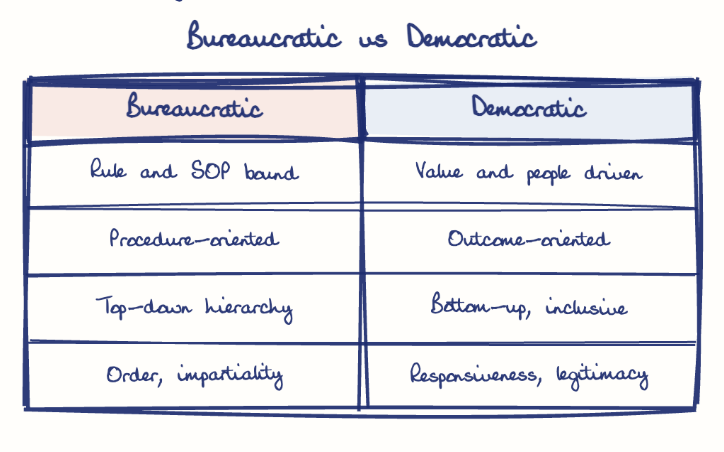
Two different kinds of attitudes exhibited by public servants towards their work have been identified as the bureaucratic attitude and the democratic attitude. Is it possible to balance the two to create a better administration for the faster development of our country?
In short
The bureaucratic and democratic attitudes can be balanced, because rules give fairness and accountability while participation gives local knowledge and legitimacy. MGNREGA's Section 17 shows the fusion, making social audit by the gram sabha a legal duty.
Model answer
Ghissu Editorial · Verified 4 Oct 2026 · 283 words
Complementary strengths
Rules give predictability, equal treatment and accountability, while participation gives local knowledge, ownership and legitimacy, each covering the other's blind spot.
Constitutional mandate
Article 14 demands non-arbitrary action, while the 73rd and 74th Amendments (1992) built participation into local government; MGNREGA's Section 17 even makes social audit a legal duty.
Firm process, open voice
EIA public hearings under the 2006 Notification let affected people be heard within a time-bound process, cutting later litigation.
Rigour with convergence
The Aspirational Districts Programme (2018) pairs ranked monthly indicators with collaboration among officials and citizens.
From rule to role
Mission Karmayogi (2020) aims to move officers from rule-based to role-based functioning, pairing procedural competence with courteous, citizen-facing behaviour at every level of service.
Citizen-centric design
The Second ARC's report on Citizen Centric Administration (2009) recommended citizens' charters and grievance redress within clear standards, as in the Sevottam model.
This model answer is indicative and the model can make mistakes; please verify key facts independently.
Practise this question
1Get the answer sheet
Sized for this question.
2Write your answer
Timed, by hand.
3Get it marked
Your score and what to fix.
This chapter in the exam
Attitude — Content, structure, function4 questions
Asked in 3 of 14 sittings since 2013
- 2021Attitude is an important component that goes as input in the development of human being. How to build a suitable attitude needed for a public servant?
- 2015Two different kinds of attitudes exhibited by public servants towards their work have been identified as the bureaucratic attitude and the democratic attitude. Distinguish between these two terms and write their merits and demerits.
All 4 questions, sorted by sub-topic, with model answers and practice.
Question from the official UPSC Civil Services (Main) Examination 2015 paper. Answer written by Ghissu's engine and checked against our editorial standards. Found an error? Tell us and we correct it within 48 hours.