2016 · GS Paper 1 · Q9 · 12 marks
"An essential condition to eradicate poverty is to liberate the poor from the process of deprivation." Substantiate this statement with suitable examples.
In short
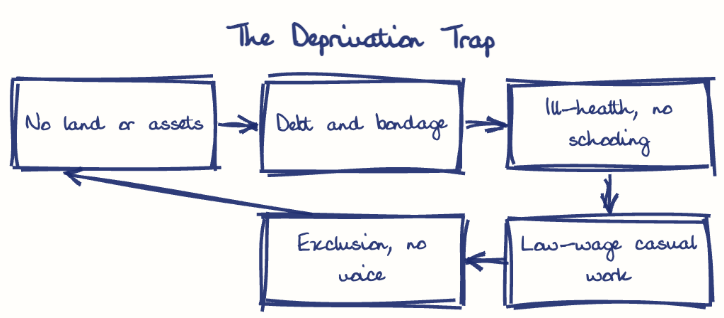
Poverty is a self-reinforcing process of landlessness, debt, ill-health, illiteracy and exclusion, so it ends only when the poor are freed from these deprivations rather than given income alone. India's multidimensional poverty fell from 29.17% in 2013-14 to 11.28% in 2022-23 (NITI Aayog).
Model answer
Ghissu Editorial · Verified 4 Oct 2026 · 272 words
Debt and bondage
Landless labourers borrow from moneylenders and slide into bondage, the reason for the Bonded Labour System (Abolition) Act, 1976.
Health and nutrition
A single illness drains a family's savings, and stunting of 35.5% among under-fives (NFHS-5, 2019-21) passes deprivation to the next generation.
Social exclusion
Caste and gender barriers, which Andre Beteille traced across caste, class and power, deny Dalits, Adivasis and women land, credit and voice, so cash transfers alone tend to leak upward to the better-off.
Kerala's model
Land reforms, universal schooling, public health and Kudumbashree (1998) gave Kerala the lowest multidimensional poverty in India.
Rights to resources
The Forest Rights Act, 2006 secured forest dwellers' land, and MGNREGA (2005) set a rural wage floor that cut distress migration and raised labourers' bargaining power.
Finance and health cover
Jan Dhan accounts and SHG credit loosened the moneylender's grip, while Ayushman Bharat-PMJAY (2018) shields households from catastrophic hospital bills.
This model answer is indicative and the model can make mistakes; please verify key facts independently.
Practise this question
1Get the answer sheet
Sized for this question.
2Write your answer
Timed, by hand.
3Get it marked
Your score and what to fix.
This chapter in the exam
Poverty and developmental issues9 questions
Asked in 6 of 14 sittings since 2013
- 2025Achieving sustainable growth with emphasis on environmental protection could come into conflict with poor people's needs in a country like India - Comment.
- 2025How does smart city in India, address the issues of urban poverty and distributive justice ?
All 9 questions, sorted by sub-topic, with model answers and practice.
Question from the official UPSC Civil Services (Main) Examination 2016 paper. Answer written by Ghissu's engine and checked against our editorial standards. Found an error? Tell us and we correct it within 48 hours.