2025 · GS Paper 1 · Q19 · 15 marks
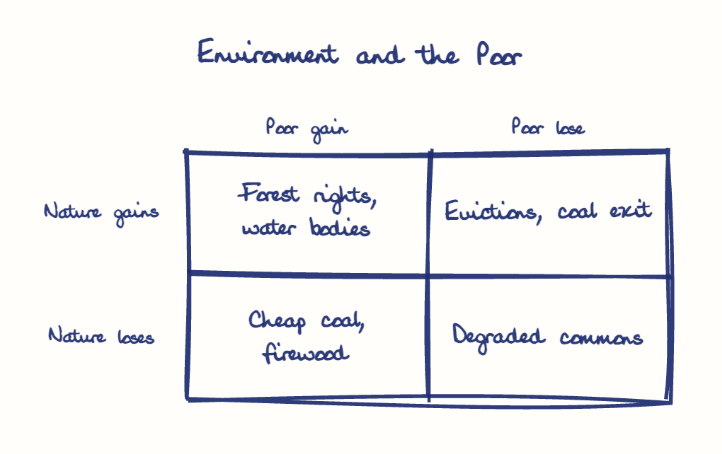
Achieving sustainable growth with emphasis on environmental protection could come into conflict with poor people's needs in a country like India - Comment.
In short
Environmental protection does conflict with the needs of India's poor in the short run, through conservation evictions, coal phase-down and pollution bans, but the conflict is not inherent because the poor depend most on nature. India's per capita emissions of 2.5 to 2.8 tonnes leave room for a just transition.
Model answer
Ghissu Editorial · Verified 4 Oct 2026 · 309 words
Conservation versus forest dwellers
In Wildlife First v. Union of India (2019), the Supreme Court ordered eviction of forest dwellers with rejected Forest Rights Act claims, then stayed the order after an outcry.
Coal exit versus livelihoods
The 2070 net-zero pledge implies a coal phase-down that threatens jobs and royalties in Jharkhand, Chhattisgarh and Odisha.
Pollution curbs versus wages
Construction bans under Delhi-NCR's Graded Response Action Plan halt daily-wage work, forcing ex gratia payments to workers.
The poor depend on nature
N.S. Jodha showed common property resources supply much of poor households' fuel, fodder and income, and Chipko (1973) was the environmentalism of the poor.
Fair carbon space
The Economic Survey 2023-24 puts India's per capita emissions at 2.5 to 2.8 tonnes against about 8 for the EU27, leaving room to grow while decarbonising.
Just transition
Reskill coal districts through District Mineral Foundation funds, and secure gram sabha consent, as upheld in the Niyamgiri case (2013), before any eviction.
Reward conservation
Compensate green-rule costs and use CAMPA funds and the Green Credit Programme (2023) to pay communities that restore ecosystems.
This model answer is indicative and the model can make mistakes; please verify key facts independently.
Practise this question
1Get the answer sheet
Sized for this question.
2Write your answer
Timed, by hand.
3Get it marked
Your score and what to fix.
This chapter in the exam
Poverty and developmental issues9 questions
Asked in 6 of 14 sittings since 2013
- 2025How does smart city in India, address the issues of urban poverty and distributive justice ?
- 2024In dealing with socio-economic issues of development, what kind of collaboration between government, NGOs and private sector would be most productive?
All 9 questions, sorted by sub-topic, with model answers and practice.
Question from the official UPSC Civil Services (Main) Examination 2025 paper. Answer written by Ghissu's engine and checked against our editorial standards. Found an error? Tell us and we correct it within 48 hours.