2025 · GS Paper 1 · Q8 · 10 marks
How does smart city in India, address the issues of urban poverty and distributive justice ?
In short
Smart cities address urban poverty indirectly through cheaper services, transparent delivery and convergence with housing schemes, but enclave-focused spending, evictions and bypassed municipal councils limit distributive justice. Integrated Command and Control Centres now run in all 100 Mission cities.
Model answer
Ghissu Editorial · Verified 4 Oct 2026 · 270 words
Citizen-led planning
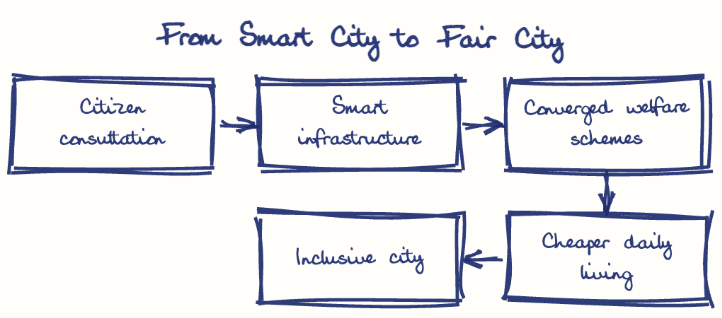
The Smart City Challenge required public consultation; Bhubaneswar topped the first round in 2016 with a participatory plan.
Cheaper services and convergence
Water, sanitation, e-buses and footpaths lower daily costs for the poor, and convergence with PMAY-Urban, AMRUT and Odisha's Jaga Mission (2018) adds housing and land rights.
Transparent delivery
Integrated Command and Control Centres, now running in all 100 cities, and online service and grievance portals cut out the middlemen and petty rent-seeking that tax the poor most.
Enclave bias and evictions
Area-Based Development favoured small, better-served pockets, and beautification drives displaced vendors and slum dwellers, as the Housing and Land Rights Network documented.
Democratic deficit
Special Purpose Vehicles registered under the Companies Act bypassed elected municipal councils, diluting the local accountability promised by the 74th Amendment.
Digital divide
App-first services exclude residents without smartphones or digital literacy, often the poorest and the elderly.
This model answer is indicative and the model can make mistakes; please verify key facts independently.
Practise this question
1Get the answer sheet
Sized for this question.
2Write your answer
Timed, by hand.
3Get it marked
Your score and what to fix.
This chapter in the exam
Poverty and developmental issues9 questions
Asked in 6 of 14 sittings since 2013
- 2025Achieving sustainable growth with emphasis on environmental protection could come into conflict with poor people's needs in a country like India - Comment.
- 2024In dealing with socio-economic issues of development, what kind of collaboration between government, NGOs and private sector would be most productive?
All 9 questions, sorted by sub-topic, with model answers and practice.
Question from the official UPSC Civil Services (Main) Examination 2025 paper. Answer written by Ghissu's engine and checked against our editorial standards. Found an error? Tell us and we correct it within 48 hours.