2016 · GS Paper 1 · Q6 · 12 marks
Has the formation of linguistic States strengthened the cause of Indian Unity?
In short
Linguistic reorganisation largely strengthened Indian unity by defusing a major grievance, deepening democracy in regional languages and channelling regional parties into constitutional politics. No state has seceded since the 1956 Act, though border disputes like Belagavi and nativist job quotas remain strains.
Model answer
Ghissu Editorial · Verified 4 Oct 2026 · 295 words
Grievance defused
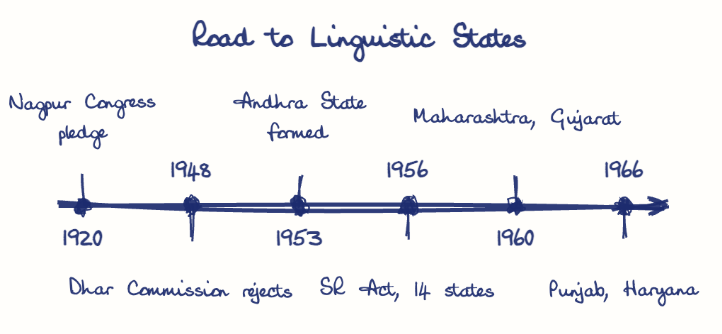
Honouring the Congress's 1920 Nagpur pledge turned a potential secessionist grievance into loyalty; Bipan Chandra holds that reorganisation removed a major source of discontent.
Democracy in the mother tongue
Administration, courts and schooling in Telugu, Marathi or Kannada drew ordinary citizens into politics, so regional pride became a route into the national project.
Federal safety valve
The DMK dropped its Dravida Nadu demand after the Sixteenth Amendment of 1963, while Articles 350A and 350B protected linguistic minorities.
Border disputes
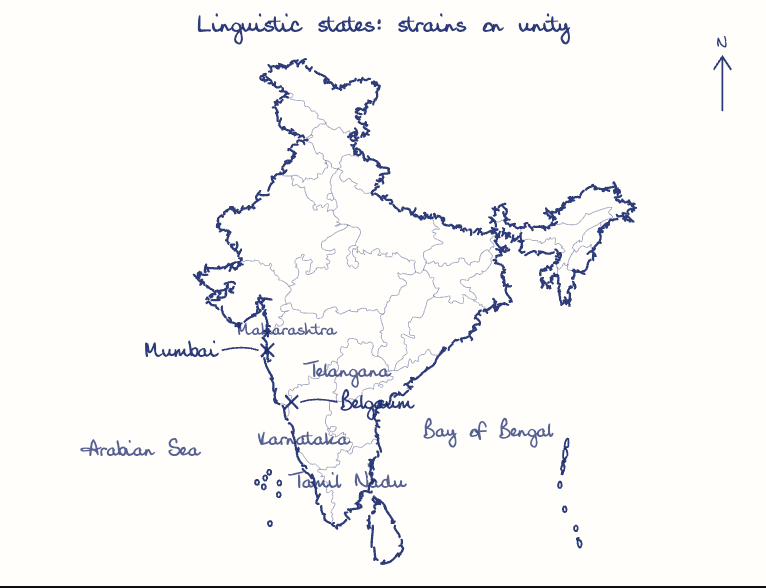
The Belagavi dispute between Maharashtra and Karnataka still sits before the Supreme Court, turning linguistic loyalty into territorial rivalry.
Sons-of-the-soil politics
From the Shiv Sena's 1966 campaign to Haryana's 2020 law reserving 75% of private jobs for locals, struck down in 2023, nativism persists.
Language wars
The 1965 anti-Hindi agitation in Tamil Nadu forced the 1967 amendment of the Official Languages Act.
Language not enough
Telangana's separation in 2014 from a Telugu-speaking state shows that language alone does not settle identity.
This model answer is indicative and the model can make mistakes; please verify key facts independently.
Practise this question
1Get the answer sheet
Sized for this question.
2Write your answer
Timed, by hand.
3Get it marked
Your score and what to fix.
This chapter in the exam
Reorganization of States (the "Linguistic" Phase)3 questions
Asked in 3 of 14 sittings since 2013
Question from the official UPSC Civil Services (Main) Examination 2016 paper. Answer written by Ghissu's engine and checked against our editorial standards. Found an error? Tell us and we correct it within 48 hours.