2016 · GS Paper 1 · Q5 · 12 marks
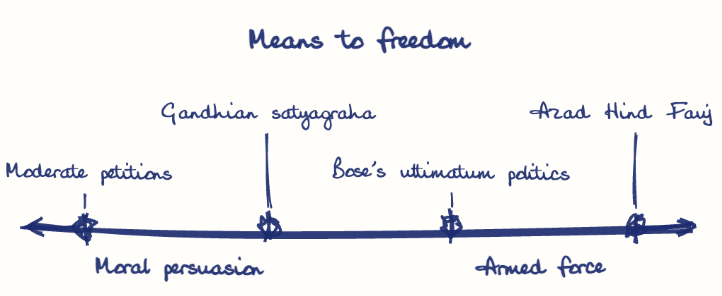
Highlight the differences in the approach of Subhash Chandra Bose and Mahatma Gandhi in the struggle for freedom.
In short
Gandhi and Bose shared the goal of complete independence but differed on non-violence versus armed struggle, village self-reliance versus planned industrialisation, and patience versus seizing Britain's wartime difficulty. Their split came at Tripuri in 1939, after which Bose formed the Forward Bloc and later the Azad Hind Fauj.
Model answer
Ghissu Editorial · Verified 4 Oct 2026 · 271 words
Means
Gandhi held ahimsa as a creed and insisted on purity of means, while Bose treated non-violence as a tactic and from 1943 led the Azad Hind Fauj.
Economic vision
Gandhi wanted self-reliant villages and khadi, whereas Bose, as Congress president, set up the National Planning Committee (1938) for state-led industrialisation.
State and idiom
Bose's The Indian Struggle (1935) wanted a strong, disciplined state, and he mobilised in a secular, military idiom of Jai Hind, unlike Gandhi's gram swaraj and Ramrajya.
Pace of struggle
Bose opposed the Gandhi-Irwin Pact (1931) and, with Vithalbhai Patel, declared Gandhi's leadership a failure in 1933.
Control of the Congress
Bose's win at Tripuri (1939) over Gandhi's nominee Pattabhi Sitaramayya led to his resignation and the Forward Bloc.
War and allies
Bose saw Britain's difficulty as India's opportunity and formed the Azad Hind government with Japanese help in 1943, while Gandhi refused to embarrass Britain in 1939, feared Japanese imperialism and opposed fascism.
This model answer is indicative and the model can make mistakes; please verify key facts independently.
Practise this question
1Get the answer sheet
Sized for this question.
2Write your answer
Timed, by hand.
3Get it marked
Your score and what to fix.
This chapter in the exam
Role of Masses and Personalities13 questions
Asked in 8 of 14 sittings since 2013
- 2026The significance of the Gandhian movements lay in the masses they mobilized. Elucidate.
- 2021Bring out the constructive programmes of Mahatma Gandhi during Non-Cooperation Movement and Civil Disobedience Movement.
All 13 questions, sorted by sub-topic, with model answers and practice.
Question from the official UPSC Civil Services (Main) Examination 2016 paper. Answer written by Ghissu's engine and checked against our editorial standards. Found an error? Tell us and we correct it within 48 hours.