2016 · GS Paper 1 · Q20 · 12 marks
In what way micro-watershed development projects help in water conservation in drought-prone and semi-arid regions of India?
In short
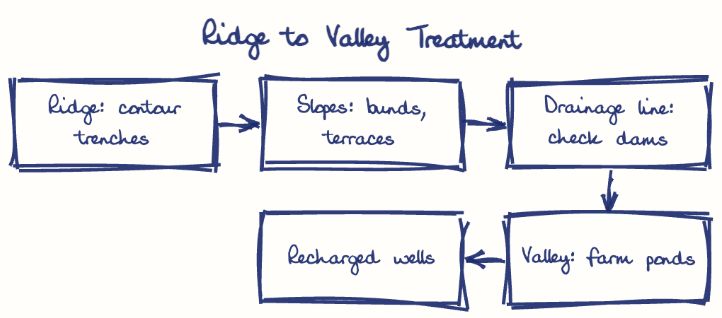
Micro-watershed projects conserve water in drought-prone and semi-arid India by treating land from ridge to valley, slowing runoff and recharging aquifers under community control. CGWB found recharge from tanks, ponds and conservation structures rising from 13.98 BCM in 2017 to 25.34 BCM in 2024.
Model answer
Ghissu Editorial · Verified 4 Oct 2026 · 276 words
Slowing runoff
Treating the upper catchment first lets rain soak in and keeps lower structures free of silt.
Recharging aquifers
Check dams and percolation tanks recharge shallow aquifers; the CGWB found recharge from tanks, ponds and conservation structures rising from 13.98 BCM in 2017 to 25.34 BCM in 2024.
Moisture and cover
Vegetative barriers and pasture on common land hold soil moisture into the rabi season.
Demand discipline
Watershed committees ration borewells and water-hungry crops so saved water is not pumped out.
Village turnarounds
Ralegan Siddhi under Anna Hazare and Hiware Bazar under Popatrao Pawar, in drought-prone Ahmednagar, moved from tankers to water sufficiency through trenching, check dams and crop limits.
River revival
Tarun Bharat Sangh's johads in semi-arid Alwar helped revive the seasonal Arvari river.
Livelihood security
Stored water allows a second crop and fodder through dry months, cutting distress migration.
Scaled programmes
The Hanumantha Rao Committee (1994) set the participatory model, now funded nationally under WDC-PMKSY 2.0 (2021-26).
This model answer is indicative and the model can make mistakes; please verify key facts independently.
Practise this question
1Get the answer sheet
Sized for this question.
2Write your answer
Timed, by hand.
3Get it marked
Your score and what to fix.
This chapter in the exam
Resources and planning38 questions
Asked in 14 of 14 sittings since 2013
- 2026"Water resources are both an asset and a source of conflict in South Asia." Examine this statement giving examples.
- 2026Analyze the role of satellite-based technologies in achieving climate-smart agriculture and food security in India.
All 38 questions, sorted by sub-topic, with model answers and practice.
Question from the official UPSC Civil Services (Main) Examination 2016 paper. Answer written by Ghissu's engine and checked against our editorial standards. Found an error? Tell us and we correct it within 48 hours.