2016 · GS Paper 1 · Q14 · 12 marks
"The Himalayas are highly prone to landslides." Discuss the causes and suggest suitable measures of mitigation.
In short
Himalayan landslides stem from young, rising, seismically active and fragile slopes, triggered by cloudbursts, glacial lake outbursts and careless road, tunnel and town building. Mitigation rests on GSI susceptibility zoning, rainfall-threshold early warning, slope engineering and the NDMA's National Landslide Risk Management Strategy (2019).
Model answer
Ghissu Editorial · Verified 4 Oct 2026 · 272 words
Young, rising mountains
Continuing plate convergence and thrusts like the Main Central Thrust leave rocks crushed and jointed in India's highest seismic hazard belt.
Extreme rain and melt
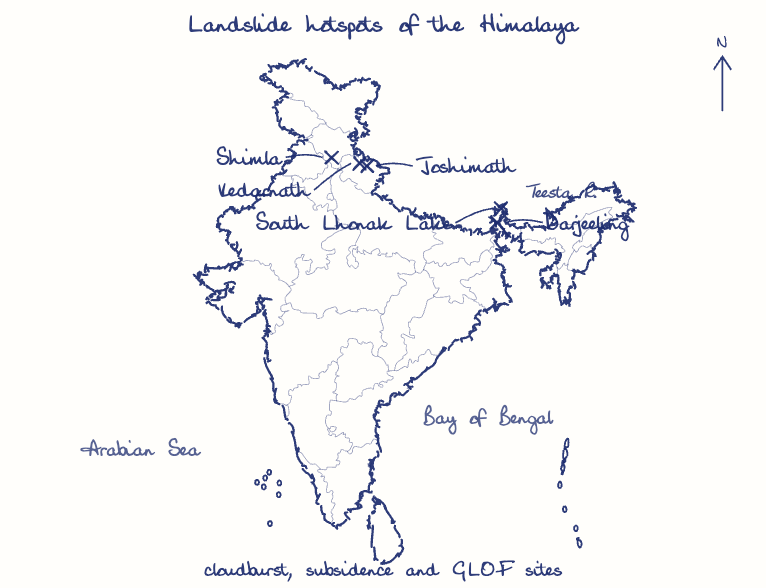
Cloudbursts from monsoon and western disturbance interaction, as at Kedarnath in 2013, and glacial lake outbursts like South Lhonak in Sikkim (2023) saturate and strip slopes.
Human disturbance
Road cutting, tunnel blasting, deforestation and unregulated building, seen at Joshimath and Shimla in 2023, turn a hazard into a disaster.
Mapping and zoning
GSI's landslide susceptibility maps should decide where roads and towns may grow, a warning the Mishra Committee gave for Joshimath in 1976.
Early warning
Rainfall-threshold forecasts piloted by GSI and sensor networks like Amrita University's in Munnar should be scaled across Himalayan districts.
Slope engineering
Retaining walls, surface drainage, rock bolting and vetiver-based bio-engineering stabilise cut slopes along highways.
Governance and community
The NDMA's National Landslide Risk Management Strategy (2019), slope audits in project clearances and Aapda Mitra volunteers build local preparedness.
This model answer is indicative and the model can make mistakes; please verify key facts independently.
Practise this question
1Get the answer sheet
Sized for this question.
2Write your answer
Timed, by hand.
3Get it marked
Your score and what to fix.
This chapter in the exam
Natural Hazards and Disasters6 questions
Asked in 5 of 14 sittings since 2013
- 2023Comment on the resource potentials of the long coastline of India and highlight the status of natural hazard preparedness in these areas.
- 2021Differentiate the causes of landslides in the Himalayan region and Western Ghats.
All 6 questions, sorted by sub-topic, with model answers and practice.
Question from the official UPSC Civil Services (Main) Examination 2016 paper. Answer written by Ghissu's engine and checked against our editorial standards. Found an error? Tell us and we correct it within 48 hours.