2016 · GS Paper 2 · Q1 · 12 marks
Discuss the essentials of the 69th Constitutional Amendment Act and anomalies, if any, that have led to recent reported conflicts between the elected representatives and the institution of the Lieutenant Governor in the administration of Delhi. Do you think that this will give rise to a new trend in the functioning of the Indian federal politics?
In short
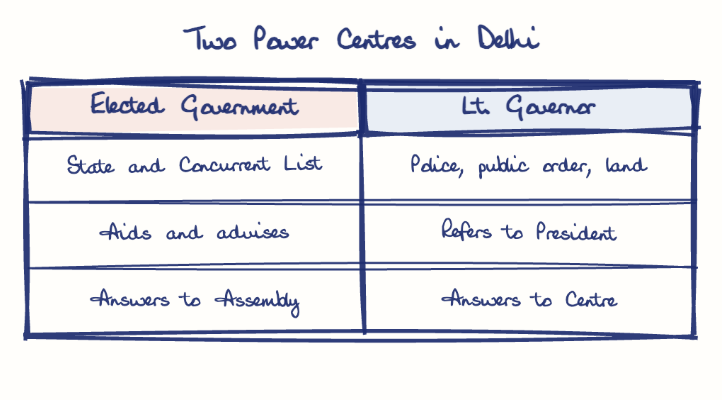
The 69th Amendment gave Delhi an elected Assembly and ministry while keeping police, public order, land and a vague 'any matter' referral power with the Lieutenant Governor, which bred conflict after 2015. An MHA notification of May 2015 vesting services in the LG triggered the sharpest of these disputes.
Model answer
Ghissu Editorial · Verified 4 Oct 2026 · 293 words
Assembly and ministry
A directly elected Assembly and a Council of Ministers capped at 10% of its strength, headed by the Chief Minister.
Parliament's primacy
Parliament may legislate on any matter for Delhi, and Article 239AB allows suspension if the machinery fails.
"Any matter" proviso
The LG may refer any difference to the President, a vague clause used to stall routine files.
Silence on services
An MHA notification of May 2015 vested services in the LG, sparking the row over the acting Chief Secretary.
Split policing and probes
Delhi Police answers to the Home Ministry, and the Anti-Corruption Branch was barred from acting against Central employees.
Judicial reading
The Delhi High Court (August 2016) held the LG to be the administrative head, not bound by advice.
Wider confrontation
Puducherry's Kiran Bedi episode and Governor-state rows over assent to Bills echo the pattern.
Limits of the template
Delhi is sui generis, so its design cannot be copied onto full states.
This model answer is indicative and the model can make mistakes; please verify key facts independently.
Practise this question
1Get the answer sheet
Sized for this question.
2Write your answer
Timed, by hand.
3Get it marked
Your score and what to fix.
This chapter in the exam
Functions and Responsibilities of the Union and the States7 questions
Asked in 7 of 14 sittings since 2013
- 2026How far has the Indian federal framework been successful in accommodating regional and cultural diversities ? Highlight the role of asymmetric federalism and suggest measures to make dispute resolution mechanisms more effective.
- 2025Examine the evolving pattern of Centre-State financial relations in the context of planned development in India. How far have the recent reforms impacted the fiscal federalism in India?
All 7 questions, sorted by sub-topic, with model answers and practice.
Question from the official UPSC Civil Services (Main) Examination 2016 paper. Answer written by Ghissu's engine and checked against our editorial standards. Found an error? Tell us and we correct it within 48 hours.